Table of Contents
Why Pain Relief Can Outpace Nerve Recovery: Monitoring Strength, Reflexes, and Sensation After Sciatica Resolves
Maria’s radiating right-leg pain had finally eased. After a rear-end collision on Loop 375, the sharp electric current that had shot from her low back into her calf for six weeks had dropped from a daily 7/10 to an occasional 2. She could sit through dinner, drive short distances, and sleep without waking to shift positions. She told the team she felt “almost normal.”
On the same visit, however, a standard neurological screen showed she still could not repeatedly rise onto the toes of her right foot without the heel dropping, her ankle reflex was clearly diminished compared with the left, and light touch along the outer side of her foot felt dull. The pain had improved. The nerve had not yet finished recovering.

This pattern is common in lumbar radiculopathy and true sciatic-nerve irritation. Pain is often the loudest symptom because inflamed or mechanically irritated nerve fibers fire pain signals early and intensely. Strength, reflexes, and precise sensation can lag because they depend on the nerve’s ability to conduct signals efficiently and the muscle’s ability to respond. When swelling around a nerve root decreases or a disc fragment shifts slightly, the pain generators quiet first. Full restoration of motor power and sensory discrimination can take weeks or months longer as the nerve remyelinates, inflammation resolves at the root, and the neuromuscular system relearns normal recruitment.
Why Doctors Keep Checking Strength, Reflexes, and Sensation
A single snapshot is never enough. Serial examinations create a timeline that distinguishes expected recovery from stalled or worsening nerve function. In the clinic, clinicians grade strength by asking the patient to push against resistance in specific muscle groups: great-toe extension and ankle dorsiflexion for L5, ankle plantarflexion and toe-walking for S1, and knee extension for L4. Reflexes are tested at the knee (L3–L4) and ankle (S1). Sensation is mapped with light touch or pinprick across dermatomes on the front of the thigh, the top of the foot, and the outer border of the foot. When you record these findings at intake, at the two-week mark, and again at four to six weeks, any change becomes visible.
Pain improvement without matching improvement in strength or reflexes is not automatically alarming, but it does change the plan. Continued soft-tissue work, gentle decompression, and carefully progressed loading may still be appropriate while the nerve catches up. The same serial record also protects the patient and the legal file: an attorney reviewing the chart can see that the residual deficit was objectively documented rather than dismissed once the patient reported less pain. Detailed explanations of how sensory nerves map to dermatomes and how deep-tendon reflexes localize nerve-root levels appear in related discussions on sensory nerves and tendon reflexes.
The Critical Red Flags
Not every residual deficit is benign. Progressive weakness, new foot drop, rapidly worsening numbness that climbs the leg, or any change in bladder or bowel control requires same-day or next-day evaluation. These signs can indicate increasing compression, a migrating disc fragment, or, rarely, cauda equina involvement. In such cases, the priority shifts from continued conservative care to urgent imaging and possible surgical consultation. Even with minimal pain, an inability to walk on toes or heels that was not present at the prior visit is treated as a new finding that must be explained.
Patients sometimes worry that reporting ongoing weakness will “undo” the progress they feel. In practice, the opposite is true. Early recognition of a worsening motor deficit allows the team to adjust load, add protective bracing if needed, or coordinate advanced imaging before permanent changes occur. Many cases that begin with clear weakness still recover fully when the mechanical pressure is reduced, and the nerve is given protected time to heal.
What Makes This Clinic Unique in El Paso
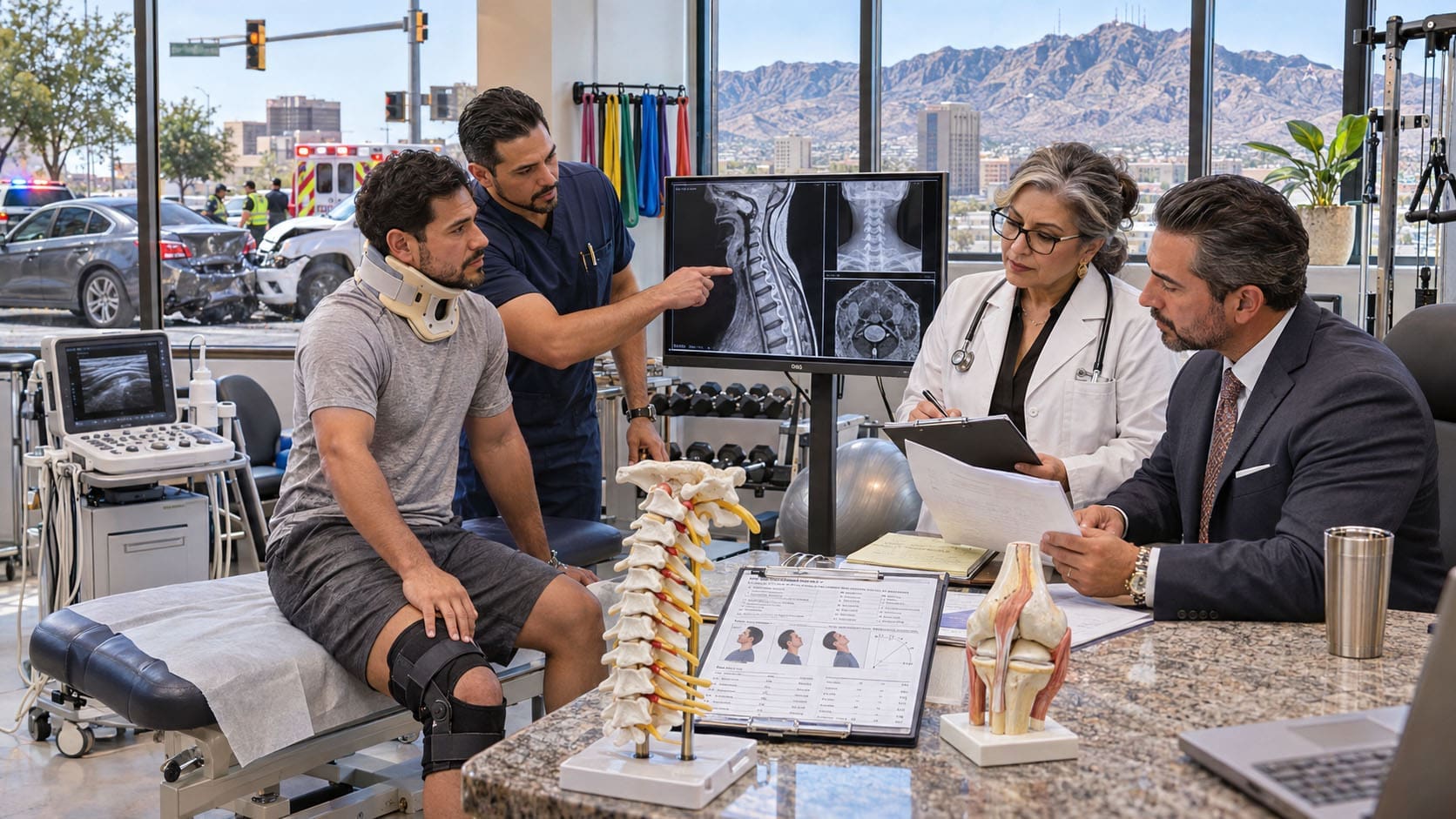
Injury Medical Chiropractic and Functional Medicine Clinic is structured so that the same patient can receive both structural and medical oversight without leaving the practice. Dr. Maria Guadalupe Cardenas, MD, serves as Medical Director and brings more than forty years of internal medicine experience to risk stratification and complex comorbidities. Dr. Alex Jimenez, DC, APRN, FNP-BC, holds dual licensure and focuses on soft-tissue injury, spinal mechanics, and neurofunctional care. Together, they document mechanical findings (range of motion, orthopedic tests, digital strength measures) and medical findings (neurologic screens, laboratory markers when indicated, medication review). This dual-scope record is the only integrated model of its kind currently available in El Paso that routinely co-documents chiropractic, advanced-practice, and medical-director notes for radiculopathy and personal-injury cases. Patients and their attorneys therefore receive a single, consistent narrative rather than fragmented reports from separate offices.
Bioethical Framing of the Monitoring Process
Beneficence is served by continuing to track the nerve even after pain recedes. The goal is root-cause recovery—restoring the ability to push off the ball of the foot, maintain balance on uneven ground, and return to work or sport without hidden deficits—rather than simply lowering a pain score. Non-maleficence is protected by choosing non-invasive options first: spinal adjustments that reduce mechanical irritation, electroacupuncture or neurofunctional techniques that calm hypersensitive nerve pathways, and progressive exercise that rebuilds strength without overloading a still-compromised root. These approaches lower the chance that a patient will escalate too quickly to heavy analgesics or premature surgery. Autonomy is preserved when the patient sees the same numbers the clinician records. Shared review of strength grades, reflex symmetry, and sensation maps lets the patient decide, with clear information, whether to continue conservative care, add imaging, or seek a surgical opinion.
Practical Steps Patients and Attorneys Can Use
Patients can help by noting not only pain levels but also functional changes: “I can now walk on my toes for five steps but not ten,” or “The outside of my foot still feels different when I put on socks.” Attorneys reviewing a file can look for dated neurologic examinations that show either improvement or stable residual findings; these entries support both medical necessity and the distinction between resolved pain and ongoing impairment under the Texas Eggshell Rule. Related clinical discussions of radiculopathy examination findings, sciatica numbness patterns in the hamstring and foot, and broader medical-legal causation principles are available on the master site at dralexjimenez.com.
When radiating leg pain improves, but strength, reflexes, or sensation have not fully returned, the correct response is to continue precise monitoring rather than discharge. The nerve’s recovery timeline is independent of the pain timeline. Serial, dual-scope documentation captures that difference, protects the patient from overlooked progression, and provides both the clinical team and legal counsel an objective record of what has healed and what still requires attention.
References
Akuthota, V., Marshall, B., Mintken, P. E., Schenkman, M., & Cleland, J. A. (2019). Clinical course of motor deficits from lumbosacral radiculopathy due to disk herniation. PM&R, 11(8), 807–814. https://doi.org/10.1002/pmrj.12082
Davis, D., & Maini, K. (2024). Sciatica. In StatPearls. StatPearls Publishing. https://www.ncbi.nlm.nih.gov/books/NBK507908/
Finucane, L. M., Downie, A., Mercer, C., Greenhalgh, S. M., Boissonnault, W. G., Pool-Goudzwaard, A. L., Beneciuk, J. M., Leech, R. L., & Selfe, J. (2020). International framework for red flags for potential serious spinal pathologies. Journal of Orthopaedic & Sports Physical Therapy, 50(7), 350–372. https://doi.org/10.2519/jospt.2020.9971
Huang, P., & Anissipour, A. (2014). How fast pain, numbness, and paresthesia resolves after lumbar nerve root decompression: A retrospective study of patient’s self-reported computerized pain drawing. Spine, 39(8), E529–E536. https://doi.org/10.1097/BRS.0000000000000212
Levin, K., Hsu, P. S., & Armon, C. (2025). Acute lumbosacral radiculopathy: Treatment and prognosis. UpToDate. https://www.uptodate.com/contents/acute-lumbosacral-radiculopathy-treatment-and-prognosis
Patel, E. A., & Perri, M. (2021). Lumbar disc herniation. Deutsches Ärzteblatt International, 118(13), 223–229. https://doi.org/10.3238/arztebl.m2021.0125
Professional Scope of Practice *
The information herein on "Sciatica Pain vs Recovery: Navigating the Healing Process" is not intended to replace a one-on-one relationship with a qualified health care professional or licensed physician and is not medical advice. We encourage you to make healthcare decisions based on your research and partnership with a qualified healthcare professional.
Blog Information & Scope Discussions
Welcome to El Paso's Premier Wellness and Injury Care Clinic & Wellness Blog, where Dr. Alex Jimenez, DC, FNP-C, a Multi-State board-certified Family Practice Nurse Practitioner (FNP-BC) and Chiropractor (DC), presents insights on how our multidisciplinary team is dedicated to holistic healing and personalized care. Our practice aligns with evidence-based treatment protocols inspired by integrative medicine principles, similar to those found on this site and our family practice-based chiromed.com site, focusing on restoring health naturally for patients of all ages.
Our areas of multidisciplinary practice include Wellness & Nutrition, Chronic Pain, Personal Injury, Auto Accident Care, Work Injuries, Back Injury, Low Back Pain, Neck Pain, Migraine Headaches, Sports Injuries, Severe Sciatica, Scoliosis, Complex Herniated Discs, Fibromyalgia, Chronic Pain, Complex Injuries, Stress Management, Functional Medicine Treatments, and in-scope care protocols.
Our information scope is multidisciplinary, focusing on musculoskeletal and physical medicine, wellness, contributing etiological viscerosomatic disturbances within clinical presentations, associated somato-visceral reflex clinical dynamics, subluxation complexes, sensitive health issues, and functional medicine articles, topics, and discussions.
We provide and present clinical collaboration with specialists from various disciplines. Each specialist is governed by their professional scope of practice and their jurisdiction of licensure. We use functional health & wellness protocols to treat and support care for musculoskeletal injuries or disorders.
Our videos, posts, topics, and insights address clinical matters and issues that are directly or indirectly related to our clinical scope of practice.
Our office has made a reasonable effort to provide supportive citations and has identified relevant research studies that support our posts. We provide copies of supporting research studies upon request to regulatory boards and the public.
We understand that we cover matters that require an additional explanation of how they may assist in a particular care plan or treatment protocol; therefore, to discuss the subject matter above further, please feel free to ask Dr. Alex Jimenez, DC, APRN, FNP-BC, or contact us at 915-850-0900.
We are here to help you and your family.
Blessings
Dr. Alex Jimenez DC, MSACP, APRN, FNP-BC*, CCST, IFMCP, CFMP, ATN
Email: [email protected]
Multidisciplinary Licensing & Board Certifications:
Licensed as a Doctor of Chiropractic (DC) in Texas & New Mexico*
Chiropractic Licenses:
Texas DC License #: TX5807, Verified: TX5807
New Mexico DC License #: NM-DC2182, Verified: NM-DC2182
Nurse Practitioner Licenses:
Texas APRN License #: 1191402, Verified: 1191402 *
New Mexico CNP License #: 90560, Verified 90560
Florida APRN License #: 11043890, Verified: APRN11043890 *
Colorado License #: C-APN.0105610-C-NP, Verified: C-APN.0105610-C-NP
New York License #: N25929, Verified N25929
Georgia APRN License #: GAA-NP005701
Multi-State Advanced Practice Registered Nurse (APRN*) Texas & Multi-States
Multi-state Compact APRN License by Endorsement (43 States)
Compact Status: Multi-State License: Authorized to Practice in 43 States*
Nursing Licensure Compact: Updated Here
DEA Registration: (Drug Enforcement Agency Registered)
All medical (MDs) and family practice providers (FNP-APRN) are registered and licensed to offer various levels of medication.
Verify Providers Here
License Verification Link: Nursys License Verifier
* Prescriptive Authority Authorized (DEA Registered Providers). Call if Required
Board Certification:
ANCC FNP-BC: Board Certified Nurse Practitioner*
Education:
Graduate with Honors: ICHS: MSN-FNP (Family Nurse Practitioner Program)
Degree Granted. Master's in Family Practice, MSN Diploma (Cum Laude)
Dr. Alex Jimenez, DC, APRN, FNP-BC*, CFMP, IFMCP, ATN, CCST
(Board Certified: Family Practice Nurse Practitioner—Multistate)*
(Licensed Nurse Practitioner & Chiropractor - Multistate)*
Clinical Director
DC & FNP License (Review Above)
Digital Business Card
NPI: 1205907805
Dr. Maria Cardenas, MD
(Board Certified: Internal Medicine)
(Licensed Medical Doctor)
Medical Director, Clinical Director & Collaborative Physician
NPI # 1164426748
MD License #: J2933
Licenses and Board Certifications:
MD: Medical Doctor
DC: Doctor of Chiropractic
APRNP: Advanced Practice Registered Nurse
FNP-BC: Family Practice Specialization (Multi-State Board Certified)
FNP-BC: Family Practice Across Life Span (Neonatal to Geriatrics)
RN: Registered Nurse (Multi-State Compact License)
CFMP: Certified Functional Medicine Provider
MSN-FNP: Master of Science in Family Practice Medicine
MSACP: Master of Science in Advanced Clinical Practice
IFMCP: Institute of Functional Medicine
CCST: Certified Chiropractic Spinal Trauma
ATN: Advanced Translational Neutrogenomics
Family with Primary Care Focus (Family Nurse Practitioner or FNP)
- The Family Nurse Practitioner (FNP) promotes, maintains, and restores health for individuals and families across the lifespan. FNPs also identify health risks, promote wellness, and diagnose and manage acute and chronic illness.
- The FNP focuses on comprehensive primary care, promoting healthy lifestyles for patients across the lifespan in settings such as private practice, physician offices, and community health centers.
Memberships & Associations:
TCA: Texas Chiropractic Association: Member ID: 104311
TNA: Texas Nurse Association: Member ID: 06458222
TNP: Texas Nurse Practitioner Association ID: 2025091511
AANP: American Association of Nurse Practitioners: Member ID: 2198960
ANA: American Nurses Association: Member ID: 06458222 (District TX01)
| Primary Taxonomy | Selected Taxonomy | State | License Number |
|---|---|---|---|
| No | 111N00000X - Chiropractor | NM | DC2182 |
| Yes | 111N00000X - Chiropractor | TX | DC5807 |
| Yes | 363LF0000X - Nurse Practitioner - Family | TX | 1191402 |
| Yes | 363LF0000X - Nurse Practitioner - Family | FL | 11043890 |
| Yes | 363LF0000X - Nurse Practitioner - Family | CO | C-APN.0105610-C-NP |
| Yes | 363LF0000X - Nurse Practitioner - Family | NY | N25929 |
| Yes | 363LF0000X - Nurse Practitioner - Family | NM |
90560 |
| Yes | 363LF0000X - Nurse Practitioner - Family | GA | GAA-NP005701 |
Dr. Alex Jimenez, DC, APRN, FNP-BC*, CFMP, IFMCP, ATN, CCST
(Board Certified: Family Practice Nurse Practitioner—Multistate)*
(Primary Care Across Lifespan—Neonatal / Pediatric / Adult / Geriatrics)
(Licensed Nurse Practitioner & Chiropractor - Multistate)*
Clinical Director
Digital Business Card
NPI: 1205907805
Dr. Maria Cardenas, MD
(Board Certified: Internal Medicine)*
(Licensed Medical Doctor)*
Medical Director, Clinical Director & Collaborative Physician
NPI # 1164426748
MD License #: J2933
📆 Schedule Appointment: Schedule 24/7 (Click Here)