“For individuals experiencing a turf toe injury, can knowing the symptoms help athletes and non-athletes with treatment, recovery time, and returning to activities?”
Turf Toe Injury
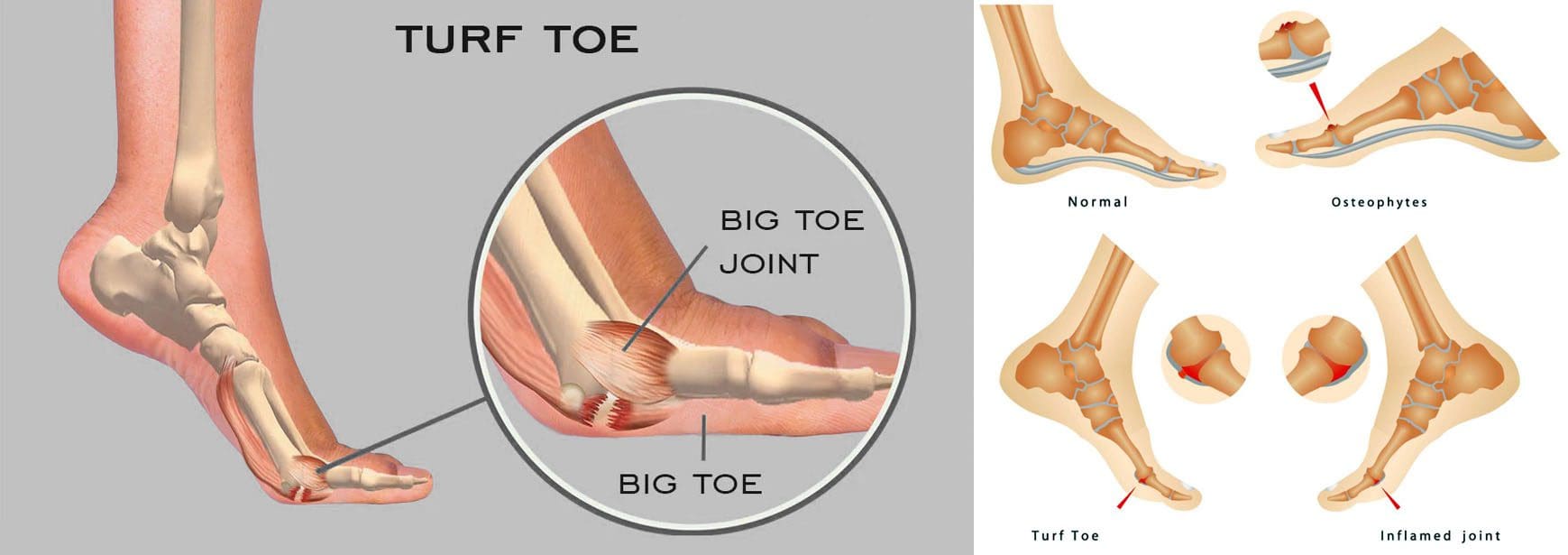
A turf toe injury affects the soft tissue ligaments and tendons at the base of the big toe under the foot. This condition usually occurs when the toe is hyperextended/forced upward, such as when the ball of the foot is on the ground and the heel is lifted. (American Academy of Orthopaedic Surgeons. 2021) The injury is common among athletes who play sports on artificial turf, which is how the injury got its name. However, it can also affect non-athletes, like individuals working on their feet all day.
- Recovery time after turf toe injury depends on the severity and the type of activities the individual plans to return to.
- Returning to high-level sports activities after a severe injury can take six months.
- These injuries vary in severity but usually improve with conservative treatment. In severe cases, surgery could be required.
- Pain is the primary issue that stops physical activities after a grade 1 injury, while grades 2 and 3 can take weeks to months to heal completely.
Meaning
A turf toe injury refers to a metatarsophalangeal joint strain. This joint comprises ligaments that connect the bone on the sole of the foot, below the big toe/proximal phalanx, to the bones that connect the toes to the larger bones in the feet/metatarsals. The injury is usually caused by hyperextension that often results from a pushing-off motion, like running or jumping.
Grading
Turf toe injuries can range from mild to severe and are graded as follows: (American Academy of Orthopaedic Surgeons. 2021)
- Grade 1 – The soft tissue is stretched, causing pain and swelling.
- Grade 2 – The soft tissue is partially torn. Pain is more pronounced, with significant swelling and bruising, and it is difficult to move the toe.
- Grade 3 – Soft tissue is completely torn, and symptoms are severe.
Is This What’s Causing My Foot Pain?
Turf toe can be an:
- Overuse injury – caused by repeating the same motion repeatedly for an extended period, that causes symptoms to worsen.
- Acute injury – that occurs suddenly, causing immediate pain.
Symptoms can include the following: (Mass General Brigham. 2023)
- Limited range-of-motion.
- Tenderness in the big toe and surrounding area.
- Swelling.
- Pain in the big toe and surrounding area.
- Bruising.
- Loose joints can indicate there is a dislocation.
Diagnosis
If experiencing turf toe symptoms, see a healthcare provider for a proper diagnosis so they can develop a personalized treatment plan. They will perform a physical exam to assess pain, swelling, and range of motion. (American Academy of Orthopaedic Surgeons. 2021) If the healthcare provider suspects tissue damage, they may recommend imaging with X-rays and (MRI) to grade the injury and determine the proper course of action.
Treatment
A healthcare provider will determine the best treatment based on the severity of the injury. All turf toe injuries can benefit from the RICE protocol: (American College of Foot and Ankle Surgeons. Foot Health Facts. 2023)
- Rest – Avoid activities that worsen symptoms. This can include using an assistive device like a walking boot or crutches to reduce pressure.
- Ice – Apply ice for 20 minutes, then wait 40 minutes before reapplying.
- Compression – Wrap the toe and foot with an elastic bandage to support and reduce swelling.
- Elevation – Prop the foot above the level of the heart to help decrease swelling.
Grade 1
Grade 1 turf toe is classified by stretched soft tissue, pain, and swelling. Treatments can include: (Ali-Asgar Najefi et al., 2018)
- Taping to support the toe.
- Wearing shoes with a rigid sole.
- Orthotic support, like a turf toe plate.
Grades 2 and 3
Grades 2 and 3 come with partial or complete tissue tearing, severe pain, and swelling. Treatments for more severe turf toe can include: (Ali-Asgar Najefi et al., 2018)
- Limited weight bearing
- Using assistive devices like crutches, a walking boot, or a cast.
Other Treatment
- Less than 2% of these injuries require surgery. It is usually recommended if there is instability in the joint or when conservative treatments are unsuccessful. (Ali-Asgar Najefi et al., 2018) (Zachariah W. Pinter et al., 2020)
- Physical therapy is beneficial for decreasing pain and improving the range of motion and strength after injury. (American Academy of Orthopaedic Surgeons. 2021)
- Physical therapy also includes proprioception and agility training exercises, orthotics, and wearing recommended shoes for specific physical activities. (Lisa Chinn, Jay Hertel. 2010)
- A physical therapist can also help ensure that the individual does not return to physical activities before the injury is fully healed and prevent the risk of re-injury.
Recovery Time
Recovery depends on injury severity. (Ali-Asgar Najefi et al., 2018)
- Grade 1 – Subjective as it varies depending on the individual’s pain tolerance.
- Grade 2 – Four to six weeks of immobilization.
- Grade 3 – Eight weeks minimum of immobilization.
- It can take up to six months to return to normal function.
Returning To Normal Activities
After a grade 1 turf toe injury, individuals can return to normal activities once the pain is under control. Grades 2 and 3 take longer to heal. Returning to sports activities after a grade 2 injury can take around two or three months, while grade 3 injuries and cases that require surgery can take up to six months. (Ali-Asgar Najefi et al., 2018)
Sports Chiropractic Treatment
References
American Academy of Orthopaedic Surgeons. (2021). Turf toe.
Mass General Brigham. (2023). Turf toe.
American College of Foot and Ankle Surgeons. Foot Health Facts. (2023). RICE protocol.
Najefi, A. A., Jeyaseelan, L., & Welck, M. (2018). Turf toe: A clinical update. EFORT open reviews, 3(9), 501–506. https://doi.org/10.1302/2058-5241.3.180012
Pinter, Z. W., Farnell, C. G., Huntley, S., Patel, H. A., Peng, J., McMurtrie, J., Ray, J. L., Naranje, S., & Shah, A. B. (2020). Outcomes of Chronic Turf Toe Repair in Non-athlete Population: A Retrospective Study. Indian journal of orthopaedics, 54(1), 43–48. https://doi.org/10.1007/s43465-019-00010-8
Chinn, L., & Hertel, J. (2010). Rehabilitation of ankle and foot injuries in athletes. Clinics in sports medicine, 29(1), 157–167. https://doi.org/10.1016/j.csm.2009.09.006