Table of Contents
Why Stress Headaches Feel Like Pressure: Understanding Nerves, Muscles, and Pain Processing
Abstract
A stress headache is often described as a tight band, squeezing sensation, or steady pressure around the forehead, temples, scalp, or back of the head. Clinically, many headaches fitting this description fall within the tension-type headache spectrum. Despite the name, modern research suggests that these headaches involve much more than tense muscles. Sensory nerves in the scalp, face, neck, and shoulders can become more sensitive, tender muscles can send repeated pain signals toward the nervous system, and the brain and spinal cord can gradually change how they process those signals. This article explains peripheral pain sensitivity, pericranial muscle tenderness, central sensitization, and why the sensation of “pressure” usually doesn’t mean dangerous pressure is building inside the skull.

That Tight-Band Headache Is More Complicated Than It Feels
After a stressful workday, you may notice something familiar.
The shoulders have slowly moved upward toward the ears. The jaw has been clenched without realizing it. The neck feels stiff. Then a dull sensation begins around the temples or forehead.
Within an hour, it may feel as though someone has wrapped a strap around the head and gradually tightened it.
Many people call this a “stress headache.” Clinically, the symptoms may resemble a tension-type headache, which is typically described as pressing or tightening rather than strongly pulsating pain.
The International Classification of Headache Disorders describes tension-type headache as commonly bilateral, pressing or tightening, mild to moderate in intensity, and generally not made substantially worse by ordinary activities such as walking or climbing stairs. Some patients also have increased tenderness in the muscles surrounding the skull (Headache Classification Committee of the International Headache Society [IHS], 2018).
But the old explanation that a tension headache is simply a muscle contracting too strongly is incomplete.
Current evidence points toward an interaction among:
- sensitive muscles and soft tissues,
- peripheral sensory nerves,
- repeated pain signals entering the nervous system,
- spinal and brain pain-processing pathways,
- sleep and stress,
- psychological and environmental influences,
- and, particularly in frequent headaches, changes in the way the central nervous system regulates pain.
In other words, muscles may contribute to the headache, but they are only one part of a larger neurological conversation (Pan et al., 2025; Steel et al., 2021).
What Does “Pressure” Actually Mean?
One of the most confusing parts of tension-type headaches is the word pressure.
Patients may say:
“My head feels pressurized.”
“It feels like my skull is being squeezed.”
“There is pressure behind my forehead.”
“It feels like something is pushing down on my head.”
These descriptions matter because they explain how the pain feels. However, they don’t automatically mean the physical pressure inside the skull has increased.
Pain Quality Is Not the Same as Intracranial Pressure
Tension-type headache is classified partly by its pressing or tightening quality.
That wording describes the brain’s perception of the sensory information it is receiving.
The skull does not need to be physically compressed for someone to experience a squeezing sensation.
Consider what happens when your arm “burns” after exercise. The arm is not literally on fire. The nervous system interprets signals from the tissues and creates the perception of burning.
A tension-type headache works similarly.
The nervous system processes signals from muscles, connective tissues, joints, and sensory nerves around the head and neck. The nervous system may interpret this as tightness, aching, heaviness, or pressure.
This differs from disorders involving true abnormal intracranial pressure.
The First Layer: Sensitive Tissues Around the Head
The muscles surrounding the skull are called the pericranial muscles.
They include structures around the:
- forehead,
- temples,
- jaw,
- back of the skull,
- upper neck,
- and shoulders.
Researchers consistently report that many people with tension-type headaches have greater tenderness in these regions than people without headaches. Tender areas frequently involve muscles such as the temporalis, masseter, trapezius, and cervical muscles (Pan et al., 2025).
Importantly, tenderness is not universal.
A person can have tension-type headaches without obvious muscle tenderness, and tender muscles can occur in people without tension-type headaches. Muscle tenderness therefore contributes useful clinical information, but it is not a stand-alone explanation or diagnostic test.
This is one reason modern headache science has moved beyond the old term “muscle-contraction headache.”
Peripheral Sensitization: Turning Up the Sensitivity of the Local Alarm System
Sensory nerves constantly monitor tissues.
Normally, they respond appropriately when the body encounters something potentially harmful. But sometimes the nerve endings themselves become easier to activate.
This process is called peripheral sensitization.
Imagine a home security alarm.
Under normal conditions, the alarm activates when someone actually tries to enter the house. If the system becomes overly sensitive, however, a delivery truck passing outside might trigger it.
Sensitized pain receptors can behave somewhat similarly.
Normal pressure or muscle activity may begin to produce stronger sensory signals than before.
Researchers studying tension-type headache have identified lower pressure-pain thresholds in some patients. In simple terms, a level of pressure that might feel merely firm to another person may feel uncomfortable or painful to someone whose pain system has become more sensitive (Pan et al., 2025).
That increased sensitivity may help explain why someone can say:
“My temples hurt when I barely touch them.”
“My scalp feels sore.”
“The muscles at the base of my skull are extremely tender.”
“My neck feels more sensitive than it should.”
These symptoms do not necessarily mean the tissue is being damaged whenever it hurts. Pain sensitivity and tissue damage are related concepts, but they are not identical.
How Tender Muscles Can Feed the Nervous System
Muscles contain sensory nerve endings that continuously report information about tension, stretch, movement, chemical conditions, and potential injury.
When muscles around the head, jaw, neck, or shoulders remain irritated or sensitive, they can provide repeated sensory input to the nervous system.
Possible contributors may include:
- sustained muscular loading,
- neck or shoulder discomfort,
- jaw clenching,
- prolonged computer positioning,
- disrupted sleep,
- physical or emotional stress,
- a previous musculoskeletal injury,
- and repetitive activities.
Researchers have also studied myofascial trigger points and tender areas within muscles in patients with tension-type headache. These findings appear common, particularly in some patients with chronic headaches, but they do not occur uniformly in everyone (Pan et al., 2025).
The important concept is not that one “knot” causes every headache.
Rather, persistent sensory information arriving from sensitive tissues may help keep the pain-processing system active.
The Second Layer: Central Pain Processing
The next part of the story takes place inside the central nervous system.
Pain is not simply generated in a muscle and delivered unchanged to the brain.
Networks in the spinal cord and brain continuously filter, amplify, dampen, compare with previous experiences, and interpret incoming sensory information.
This is why two people can experience the same physical stimulus very differently.
The Nervous System Has a Volume Control
Think of pain processing as an amplifier.
When the system is functioning normally, sensory input enters at an appropriate volume.
With repeated or prolonged pain input, the system may gradually become more responsive. Researchers call this central sensitization.
The nervous system essentially becomes better at producing a pain response.
A relatively modest amount of sensory input can then generate disproportionately noticeable symptoms.
Central sensitization appears particularly important in chronic tension-type headache, while peripheral mechanisms may play a larger role in some episodic presentations (Pan et al., 2025; Repiso-Guardeño et al., 2023).
This helps explain why chronic headache cannot always be understood by simply finding one tight muscle and attempting to relax it.
The nervous system itself may have changed how strongly it responds.
The Brain Can Also Lose Some of Its Braking Ability
Pain-processing pathways do more than amplify signals.
The brain also has systems that help suppress unnecessary pain information.
Think of these pathways as neurological brakes.
Current tension-type headache research suggests that impaired descending pain modulation may contribute to some chronic headache patterns. Instead of efficiently quieting incoming pain signals, the nervous system may allow more of them to reach conscious awareness (Pan et al., 2025).
This creates a cycle:
Sensitive tissues → increased sensory input → greater central responsiveness → stronger pain perception → continued guarding and sensitivity.
That cycle helps explain why a headache that originally appeared after a difficult week, poor sleep, or neck strain may eventually become much easier to trigger.
Why Stress Matters Without Making the Headache “Psychological”
Calling these symptoms a stress headache can create another misunderstanding.
Stress does not mean the headache is imaginary.
Stress produces real physiological effects.
It can alter:
- muscle activity,
- breathing patterns,
- jaw clenching,
- sleep quality,
- autonomic nervous-system activity,
- hormone signaling,
- attention toward painful sensations,
- and the brain’s ability to regulate pain.
Studies examining tension-type headache support an interaction among musculoskeletal input, central nervous-system function, sleep, emotional factors, and stress rather than a single cause (Repiso-Guardeño et al., 2023).
Stress may therefore lower the threshold at which an already-sensitive nervous system begins producing symptoms.
This is fundamentally different from telling a patient, “Your headache is just stress.”
Neck Signals and Headache Signals Can Overlap
The upper cervical region and head also share important neurological connections.
Sensory information from cervical tissues can interact with pathways that process signals from the head and face. This neurological overlap helps clinicians understand why neck symptoms and headaches sometimes occur together.
However, not every headache accompanied by neck tightness is caused by the cervical spine.
A clinical evaluation must differentiate among possibilities such as:
- tension-type headache,
- migraine,
- cervicogenic headache,
- occipital neuralgia,
- temporomandibular disorders,
- medication-overuse headache,
- post-traumatic headache,
- and secondary medical causes.
For a broader discussion of how these patterns overlap, see Dr. Jimenez’s Integrated Headache Management: Seven Patterns. Integrated Headache Management: Seven Patterns
Stress Headaches After a Car Accident Deserve Special Attention
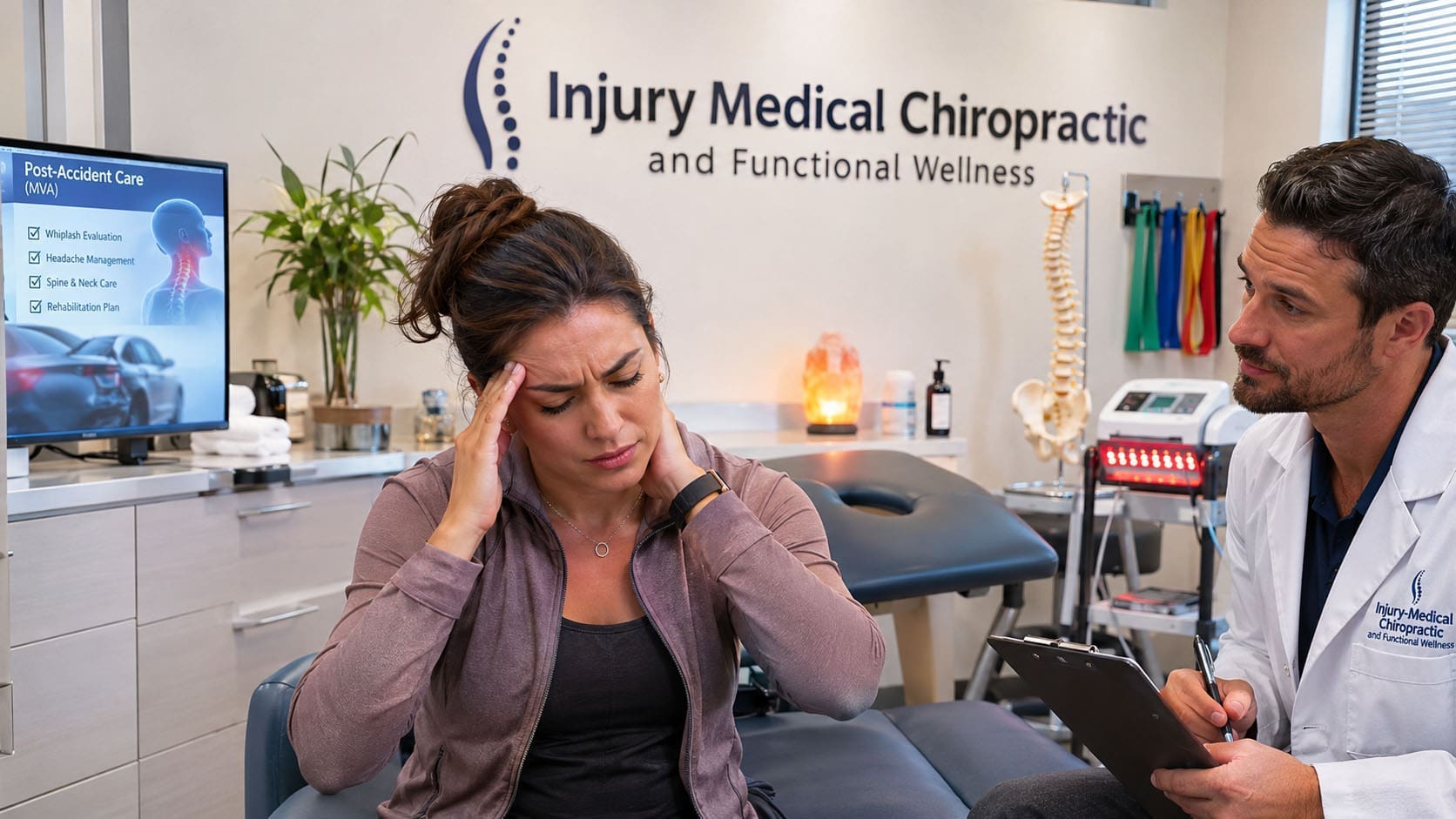
After a motor vehicle collision, patients may experience muscle guarding, disrupted sleep, anxiety, cervical irritation, altered activity, and increased tenderness in the neck and shoulder region.
These factors can contribute to a headache with tension-type features.
However, a headache beginning after trauma should not automatically be dismissed as a simple stress headache.
Post-traumatic headaches can resemble tension-type headache or migraine, and concussion, cervical injury, neurological complications, or other secondary conditions may need to be considered.
The collision history, symptom timing, neurological findings, cervical exam, headache history, and associated symptoms all matter.
When “Pressure” Should Be Evaluated Promptly
Most pressure-like headaches do not indicate dangerous pressure inside the skull. Nevertheless, new, severe, rapidly changing, or neurologically unusual headaches require appropriate medical evaluation.
Urgent assessment may be appropriate when a headache is accompanied by symptoms such as:
- a sudden “thunderclap” onset,
- new weakness or numbness,
- difficulty speaking,
- confusion or loss of consciousness,
- severe balance problems,
- seizure,
- fever with significant neck stiffness,
- persistent vomiting,
- major recent head trauma,
- significant new visual disturbances,
- or a rapidly worsening headache pattern.
The point is not to frighten patients experiencing an ordinary tension-type headache.
It is to distinguish the common sensation of pressure from disorders that require further investigation.
Why an Integrated Examination Can Be Helpful
Because tension-type headache may involve muscles, sensory nerves, cervical structures, lifestyle factors, and central pain processing, treatment decisions should follow the clinical findings rather than assuming every patient has the same underlying problem.
Depending on the diagnosis, an individualized conservative plan may include:
- therapeutic exercise,
- cervical and shoulder rehabilitation,
- mobility work,
- soft-tissue treatment,
- ergonomic modification,
- sleep and stress-management strategies,
- appropriately selected chiropractic or manual care,
- acupuncture or electroacupuncture,
- physical activity progression,
- and medical evaluation when symptoms warrant it.
Evidence on manual therapies varies by headache diagnosis and intervention, reinforcing the importance of identifying the headache pattern before selecting treatment. Contemporary research increasingly favors a multimodal rather than single-mechanism approach to tension-type headache (Pan et al., 2025; Steel et al., 2021).
Patients interested in the acupuncture component of integrative headache management can also review Reducing Headaches With Acupuncture. Reducing Headaches With Acupuncture: All You Need to Know
What Makes Dr. Jimenez’s Injury Medical Chiropractic and Functional Medicine Clinic Different?
- Dr. Alex Jimenez’s Injury Medical Chiropractic and Functional Medicine Clinic in El Paso uses a multidisciplinary model that evaluates patients from several clinical perspectives rather than relying on a single treatment discipline.
- Dr. Maria Guadalupe Cardenas, MD, a board-certified internal medicine physician with more than 40 years of experience, serves as medical director and collaborative physician.
- Dr. Alex Jimenez, DC, APRN, FNP-BC, CFMP, IFMCP, combines his chiropractic background with advanced-practice nursing and focuses extensively on musculoskeletal, neurological, and soft-tissue injury assessment. The integrated clinical team also provides advanced-practice evaluation for patients with soft-tissue and injury-related conditions.
This structure places the practice among a relatively small group of El Paso clinics that coordinate medical oversight, musculoskeletal examination, neurological screening, rehabilitation, chiropractic care, functional-medicine assessment, acupuncture, electroacupuncture, and selected advanced non-surgical therapies within the same injury-care environment. Treatment remains individualized based on diagnosis, medical necessity, patient goals, safety considerations, and informed patient choice.
Patients can learn more about this coordinated model through the clinic’s Integrative Medical and Diagnostic Centers page. Integrative Medical and Diagnostic Centers
The Bigger Picture: A Tight Band Is a Nervous-System Experience
The most important lesson is simple:
A tension-type headache is not merely a tight muscle.
Muscles may become tender. Peripheral sensory nerves may become increasingly responsive. Repeated sensory signals may enter the nervous system. Central pain-processing networks may become more sensitive, while normal pain-inhibiting mechanisms may become less effective.
The brain then interprets this complex pattern of information as the characteristic dull, tight, pressing, or band-like sensation patients recognize as a stress headache.
Understanding this process can be reassuring.
Feeling “pressure” does not automatically mean dangerous pressure is accumulating inside the skull. In many tension-type headaches, pressure is simply the language the nervous system uses to describe the pain.
At the same time, don’t self-diagnose headache patterns based solely on how they feel. When headaches become frequent, change significantly, follow trauma, or occur with neurological warning signs, a comprehensive clinical evaluation can help determine what is actually driving the symptoms and which treatment approach is most appropriate.
References
Headache Classification Committee of the International Headache Society. (2018). The International Classification of Headache Disorders, 3rd edition. Cephalalgia, 38(1), 1–211. The International Classification of Headache Disorders, 3rd edition
Pan, L.-L. H., Ling, Y.-H., Wang, S.-J., et al. (2025). Hallmarks of primary headache: Part 2—Tension-type headache. The Journal of Headache and Pain, 26, 164. Hallmarks of primary headache: Part 2—Tension-type headache
Repiso-Guardeño, Á., Moreno-Morales, N., Labajos-Manzanares, M. T., Rodríguez-Martínez, M. C., & Armenta-Peinado, J. A. (2023). Does tension headache have a central or peripheral origin? Current state of affairs. Current Pain and Headache Reports, 27, 801–810. Does Tension Headache Have a Central or Peripheral Origin? Current State of Affairs
Steel, S. J., Robertson, C. E., & Whealy, M. A. (2021). Current understanding of the pathophysiology and approach to tension-type headache. Current Neurology and Neuroscience Reports, 21(10), 56. Current Understanding of the Pathophysiology and Approach to Tension-Type Headache
Professional Scope of Practice *
The information herein on "Stress Headache Pressure Causes and Symptoms Explained" is not intended to replace a one-on-one relationship with a qualified health care professional or licensed physician and is not medical advice. We encourage you to make healthcare decisions based on your research and partnership with a qualified healthcare professional.
Blog Information & Scope Discussions
Welcome to El Paso's Premier Wellness and Injury Care Clinic & Wellness Blog, where Dr. Alex Jimenez, DC, FNP-C, a Multi-State board-certified Family Practice Nurse Practitioner (FNP-BC) and Chiropractor (DC), presents insights on how our multidisciplinary team is dedicated to holistic healing and personalized care. Our practice aligns with evidence-based treatment protocols inspired by integrative medicine principles, similar to those found on this site and our family practice-based chiromed.com site, focusing on restoring health naturally for patients of all ages.
Our areas of multidisciplinary practice include Wellness & Nutrition, Chronic Pain, Personal Injury, Auto Accident Care, Work Injuries, Back Injury, Low Back Pain, Neck Pain, Migraine Headaches, Sports Injuries, Severe Sciatica, Scoliosis, Complex Herniated Discs, Fibromyalgia, Chronic Pain, Complex Injuries, Stress Management, Functional Medicine Treatments, and in-scope care protocols.
Our information scope is multidisciplinary, focusing on musculoskeletal and physical medicine, wellness, contributing etiological viscerosomatic disturbances within clinical presentations, associated somato-visceral reflex clinical dynamics, subluxation complexes, sensitive health issues, and functional medicine articles, topics, and discussions.
We provide and present clinical collaboration with specialists from various disciplines. Each specialist is governed by their professional scope of practice and their jurisdiction of licensure. We use functional health & wellness protocols to treat and support care for musculoskeletal injuries or disorders.
Our videos, posts, topics, and insights address clinical matters and issues that are directly or indirectly related to our clinical scope of practice.
Our office has made a reasonable effort to provide supportive citations and has identified relevant research studies that support our posts. We provide copies of supporting research studies upon request to regulatory boards and the public.
We understand that we cover matters that require an additional explanation of how they may assist in a particular care plan or treatment protocol; therefore, to discuss the subject matter above further, please feel free to ask Dr. Alex Jimenez, DC, APRN, FNP-BC, or contact us at 915-850-0900.
We are here to help you and your family.
Blessings
Dr. Alex Jimenez DC, MSACP, APRN, FNP-BC*, CCST, IFMCP, CFMP, ATN
Email: [email protected]
Multidisciplinary Licensing & Board Certifications:
Licensed as a Doctor of Chiropractic (DC) in Texas & New Mexico*
Chiropractic Licenses:
Texas DC License #: TX5807, Verified: TX5807
New Mexico DC License #: NM-DC2182, Verified: NM-DC2182
Nurse Practitioner Licenses:
Texas APRN License #: 1191402, Verified: 1191402 *
New Mexico CNP License #: 90560, Verified 90560
Florida APRN License #: 11043890, Verified: APRN11043890 *
Colorado License #: C-APN.0105610-C-NP, Verified: C-APN.0105610-C-NP
New York License #: N25929, Verified N25929
Georgia APRN License #: GAA-NP005701
Multi-State Advanced Practice Registered Nurse (APRN*) Texas & Multi-States
Multi-state Compact APRN License by Endorsement (43 States)
Compact Status: Multi-State License: Authorized to Practice in 43 States*
Nursing Licensure Compact: Updated Here
DEA Registration: (Drug Enforcement Agency Registered)
All medical (MDs) and family practice providers (FNP-APRN) are registered and licensed to offer various levels of medication.
Verify Providers Here
License Verification Link: Nursys License Verifier
* Prescriptive Authority Authorized (DEA Registered Providers). Call if Required
Board Certification:
ANCC FNP-BC: Board Certified Nurse Practitioner*
Education:
Graduate with Honors: ICHS: MSN-FNP (Family Nurse Practitioner Program)
Degree Granted. Master's in Family Practice, MSN Diploma (Cum Laude)
Dr. Alex Jimenez, DC, APRN, FNP-BC*, CFMP, IFMCP, ATN, CCST
(Board Certified: Family Practice Nurse Practitioner—Multistate)*
(Licensed Nurse Practitioner & Chiropractor - Multistate)*
Clinical Director
DC & FNP License (Review Above)
Digital Business Card
NPI: 1205907805
Dr. Maria Cardenas, MD
(Board Certified: Internal Medicine)
(Licensed Medical Doctor)
Medical Director, Clinical Director & Collaborative Physician
NPI # 1164426748
MD License #: J2933
Licenses and Board Certifications:
MD: Medical Doctor
DC: Doctor of Chiropractic
APRNP: Advanced Practice Registered Nurse
FNP-BC: Family Practice Specialization (Multi-State Board Certified)
FNP-BC: Family Practice Across Life Span (Neonatal to Geriatrics)
RN: Registered Nurse (Multi-State Compact License)
CFMP: Certified Functional Medicine Provider
MSN-FNP: Master of Science in Family Practice Medicine
MSACP: Master of Science in Advanced Clinical Practice
IFMCP: Institute of Functional Medicine
CCST: Certified Chiropractic Spinal Trauma
ATN: Advanced Translational Neutrogenomics
Family with Primary Care Focus (Family Nurse Practitioner or FNP)
- The Family Nurse Practitioner (FNP) promotes, maintains, and restores health for individuals and families across the lifespan. FNPs also identify health risks, promote wellness, and diagnose and manage acute and chronic illness.
- The FNP focuses on comprehensive primary care, promoting healthy lifestyles for patients across the lifespan in settings such as private practice, physician offices, and community health centers.
Memberships & Associations:
TCA: Texas Chiropractic Association: Member ID: 104311
TNA: Texas Nurse Association: Member ID: 06458222
TNP: Texas Nurse Practitioner Association ID: 2025091511
AANP: American Association of Nurse Practitioners: Member ID: 2198960
ANA: American Nurses Association: Member ID: 06458222 (District TX01)
| Primary Taxonomy | Selected Taxonomy | State | License Number |
|---|---|---|---|
| No | 111N00000X - Chiropractor | NM | DC2182 |
| Yes | 111N00000X - Chiropractor | TX | DC5807 |
| Yes | 363LF0000X - Nurse Practitioner - Family | TX | 1191402 |
| Yes | 363LF0000X - Nurse Practitioner - Family | FL | 11043890 |
| Yes | 363LF0000X - Nurse Practitioner - Family | CO | C-APN.0105610-C-NP |
| Yes | 363LF0000X - Nurse Practitioner - Family | NY | N25929 |
| Yes | 363LF0000X - Nurse Practitioner - Family | NM |
90560 |
| Yes | 363LF0000X - Nurse Practitioner - Family | GA | GAA-NP005701 |
Dr. Alex Jimenez, DC, APRN, FNP-BC*, CFMP, IFMCP, ATN, CCST
(Board Certified: Family Practice Nurse Practitioner—Multistate)*
(Primary Care Across Lifespan—Neonatal / Pediatric / Adult / Geriatrics)
(Licensed Nurse Practitioner & Chiropractor - Multistate)*
Clinical Director
Digital Business Card
NPI: 1205907805
Dr. Maria Cardenas, MD
(Board Certified: Internal Medicine)*
(Licensed Medical Doctor)*
Medical Director, Clinical Director & Collaborative Physician
NPI # 1164426748
MD License #: J2933
📆 Schedule Appointment: Schedule 24/7 (Click Here)