Table of Contents
Innovative Light Therapies in Musculoskeletal Care: How Light and Cellular Therapies Are Revolutionizing Orthopedic and Integrative Treatment
Abstract
This educational post explores the profound connection between light energy and cellular healing, with a focus on Photobiomodulation (PBM) Therapy. I will guide you through the scientific principles of how light, specifically from advanced laser systems, can influence cellular behavior to promote healing, reduce inflammation, and alleviate pain. We’ll delve into the mechanisms behind PBM, from mitochondrial activation and ATP production to its effects on gene transcription and cytokine expression. Drawing on the latest research, including compelling studies from the veterinary field and foundational human cell-based studies, I will illustrate how PBM synergizes with orthobiologics such as Platelet-Rich Plasma (PRP). Furthermore, this post highlights our unique multidisciplinary approach at Injury Medical Clinic, where we integrate advanced therapies such as PBM with chiropractic care, under the medical direction of our esteemed colleague, Dr. Maria Guadalupe Cardenas, MD, to provide comprehensive, evidence-based patient care.
Our Integrative Approach: A Multidisciplinary Powerhouse
At Injury Medical Clinic, our philosophy is centered on an integrative, patient-focused model. I am Dr. Alex Jimenez, and my extensive training across chiropractic, nursing, and functional medicine allows me to view health through a multifaceted lens. This vision is strengthened and grounded by our collaboration with Dr. Maria Guadalupe Cardenas, MD. Dr. Cardenas is Board Certified in Internal Medicine and serves as our Medical Director. With over 40 years of experience, her medical oversight is invaluable, ensuring our treatment plans are safe, effective, and medically sound.
This collaborative structure is common in leading integrative and injury care practices. It allows us to combine the strengths of different disciplines for a synergistic effect. My role involves applying chiropractic adjustments to restore biomechanical function, utilizing functional medicine to address underlying systemic issues, and implementing advanced rehabilitation protocols. Dr. Cardenas provides the essential medical framework, overseeing diagnoses and ensuring our innovative therapies align with established medical standards. Together, our team provides a spectrum of care that includes:
- Chiropractic Care: Focused on spinal alignment, nervous system function, and biomechanical integrity.
- Medical Oversight (Internal Medicine): Ensuring comprehensive diagnostic and treatment safety.
- Functional Medicine: Investigating the root causes of chronic conditions.
- Personal Injury and Rehabilitation: Specialized protocols for acute and chronic injuries.
- Advanced Therapies: Including Photobiomodulation (PBM) to accelerate healing at the cellular level.
This integrated model allows us to do more than just manage symptoms; it empowers us to facilitate true healing from the inside out.
The Untapped Power of Light: Understanding Photobiomodulation
For nearly a decade, I’ve been a vocal advocate for the therapeutic use of light, a journey that wasn’t always met with open arms. The concept of using a laser to heal was often dismissed. However, persistent research and undeniable clinical results have shifted the conversation.
To understand Photobiomodulation, let’s start with a fundamental biological process: photosynthesis. We all accept that sunlight provides energy for plants to grow and for them to convert carbon dioxide into the oxygen we breathe. Our own bodies, having evolved for hundreds of thousands of years under that same sun, have cells that are inherently sensitive to light. A well-accepted example is the synthesis of Vitamin D, which requires sun exposure. Yet, the broader therapeutic potential of light, or Photobiomodulation Therapy (PBM), is strangely absent from modern medical school curricula.
The term itself breaks down quite simply:
- Photo: Light
- Bio: Life
- Modulation: To influence or affect
In essence, PBM is the use of light energy to create a biological response within our cells. Photons, the fundamental units of light, act like currency, transferring energy to our cells. This energy transfer doesn’t just treat a condition; it empowers the body’s own cells to initiate a healing response. This marks a shift from a mechanical mindset of “fixing” a problem to a biological one of cultivating an environment for self-repair.
The Cellular Symphony: How PBM Orchestrates Healing
When we talk about cellular therapy, whether it’s biologics or PBM, we are ultimately focused on one thing: cellular recovery. The goal is to optimize cellular function to achieve better clinical outcomes—less shoulder pain, faster knee recovery, and improved overall function.
Here’s a step-by-step journey of what happens inside your body during PBM therapy:
1. Mitochondrial Activation and Energy Production
The primary target of PBM within the cell is the mitochondria, our cellular powerhouses. A specific enzyme in the mitochondrial respiratory chain, cytochrome c oxidase, acts as a photoacceptor. This means it becomes excited by light photons of specific wavelengths.
- When photons are absorbed, the enzyme becomes more active.
- This boosts the efficiency of the Krebs cycle, leading to a cascade of events.
- The result is increased production of Adenosine Triphosphate (ATP), the direct energy currency of the cell.
- Simultaneously, signaling molecules such as nitric oxide and reactive oxygen species (ROS) are released in controlled, beneficial amounts.
2. Genetic Messaging and Immune Modulation
The downstream effects are even more fascinating. The signals initiated in the mitochondria travel to the cell’s nucleus and trigger gene transcription. This process activates the production of proteins called cytokines, which are crucial chemical messengers for the immune system.
PBM helps orchestrate a shift from a pro-inflammatory state to an anti-inflammatory, reparative one.
- Increases Anti-Inflammatory Cytokines: Research clearly documents that PBM can increase levels of interleukin-10 (IL-10), a potent anti-inflammatory cytokine.
- Reduces Pro-Inflammatory Cytokines: It also lowers levels of pro-inflammatory cytokines, such as interleukin-6 (IL-6).
This modulation is key. In an acute injury, inflammation is a necessary first step, bringing platelets and white blood cells to the site. However, in chronic conditions like a thickened Achilles tendon, the inflammatory process has stalled. PBM helps restart and guide this process toward resolution and healing.
3. Promoting Tissue Repair and Regeneration
The beneficial effects of PBM extend to multiple tissue types, creating a comprehensive healing environment:
- Angiogenesis (New Blood Vessel Formation): PBM stimulates the release of cytokines such as galectin-1, which promote the growth of new blood vessels. This improved microcirculation delivers more oxygen and nutrients to the damaged area, which is essential for any healing response.
- Neurogenesis (Nerve Repair): PBM can stimulate nerve repair and axonal growth, as evidenced by increased levels of specific proteins such as hnRNP K. This is particularly relevant in my practice, where we treat conditions like sciatica and other neuropathies.
- Muscle Recovery: Electron microscopy studies show that PBM enhances muscle cell development and increases myoglobin production, thereby improving oxygenation and accelerating recovery after injury or strenuous exercise.
- Fibroblast Activation: PBM fuels fibroblasts, the cells that produce collagen and build the structural framework for tissue repair.
By orchestrating this cascade, PBM doesn’t just mask pain—it fundamentally alters the cellular environment to resolve the underlying pathology. This explains why it is effective for so many conditions ending in “-itis” (inflammation).
The Science of Application: Wavelength, Power, and Synergy
For PBM to be effective, the light energy must reach the target tissue. The ability of photons to penetrate the body is governed by the electromagnetic spectrum. There exists a “therapeutic window,” typically between 600 nm (red light) and 1200 nm (near-infrared light), where light can penetrate tissue most effectively.
Three main barriers limit penetration: skin (melanin), blood (hemoglobin), and water.
- Red light (around 600-700 nm) is excellent for superficial tissues, penetrating only 3-4 millimeters, making it ideal for skin conditions.
- Near-infrared light (around 800-1100 nm) penetrates much deeper, allowing us to reach muscles, tendons, ligaments, and joints.
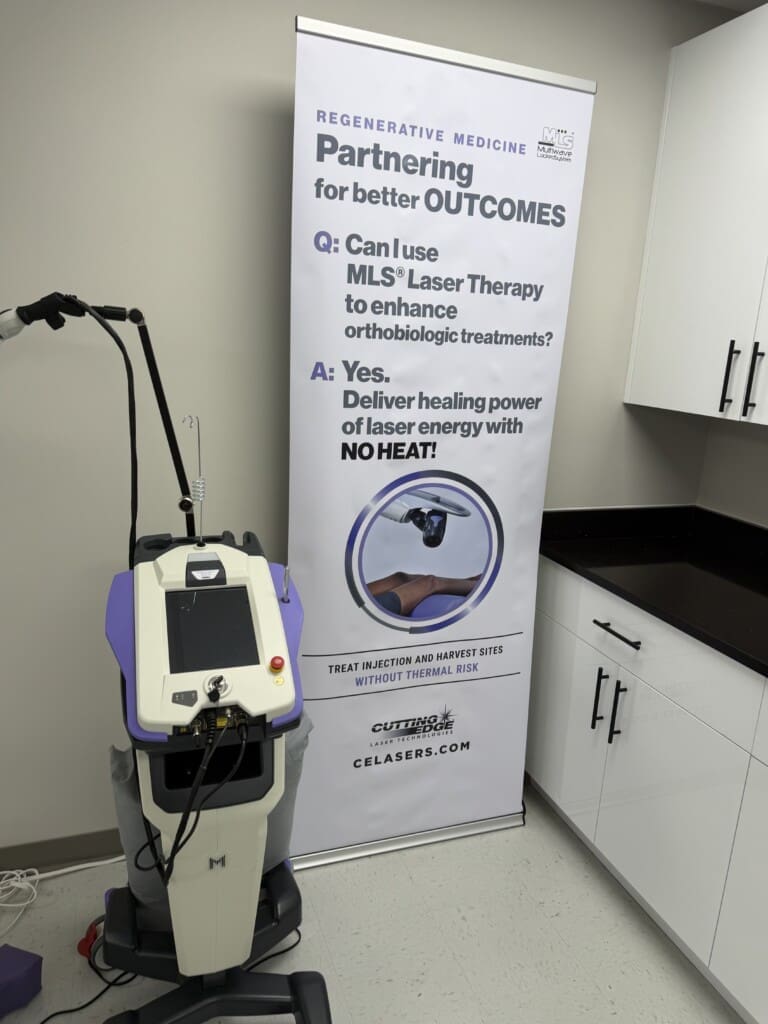
This is why not all lasers are created equal. At our clinic, we utilize advanced systems like the MLS (Multiwave Locked System) Laser. This technology is a game-changer because it synchronizes two different wavelengths:
- A continuous wave (e.g., 808 nm) for anti-inflammatory and anti-edemic effects.
- A pulsed wave (e.g., 905 nm) for analgesic (pain-relieving) effects.
The laser pulses extremely rapidly (up to 1,500 times per second), allowing the tissue to absorb photon energy without accumulating excessive heat. This makes the treatment incredibly safe and effective, allowing us to deliver a therapeutic dose of energy deep into the tissue without risk of thermal damage.
Combining Forces: PBM and Orthobiologics
This brings us to one of the most exciting frontiers in regenerative medicine: the synergy between PBM and orthobiologics like Platelet-Rich Plasma (PRP). PRP treatments introduce a concentrated cocktail of growth factors and anti-inflammatory proteins directly into an injured area. This is a powerful “message” telling the local cells to initiate repair.
Now, imagine providing the “fuel” for that repair work.
- The Message: PRP delivers the growth factors and signaling molecules.
- The Fuel: PBM activates the mitochondria, increases ATP production, and primes cells to execute the instructions delivered by the PRP.
This combination has the potential to dramatically improve cellular activity and, consequently, clinical outcomes. While more large-scale human studies are needed, the existing evidence is compelling. A fantastic randomized controlled trial in canines with knee osteoarthritis demonstrated this synergy perfectly. Dogs were treated with PBM alone, then PRP alone, and finally a combination of both. The combination therapy produced significantly better results. As I often say, dogs don’t have secondary gain; when a treatment works, the results are undeniable.
The Evidence is Mounting
The use of PBM is not speculative. There are over 7,000 published studies on its effects, with applications expanding from orthopedics to oncology, ophthalmology, and even neurology, for conditions such as Parkinson’s and depression.
Major health organizations are taking note:
- The American Academy of Orthopaedic Surgeons (AAOS) now includes laser therapy in its clinical guidelines for knee osteoarthritis.
- The Centers for Disease Control and Prevention (CDC), in its revised opioid guidelines, mentions “laser photobiomodulation” approximately 40 times as a non-pharmacological option for acute, subacute, and chronic pain.
My passion for advancing this science led me to collaborate with the Mass General Brigham Enable BioSkills Lab on a study with my son, Zachary. We took human tenocytes (tendon cells) and exposed them to an ND: YAG laser. We demonstrated a 20% dose-dependent increase in tenocyte proliferation with PBM alone. We are now analyzing the genetic messaging (qPCR) and protein expression (ELISA) to further map out the precise cellular mechanisms.
The Future is Biological
The future of orthopedics and injury recovery lies in biology. Instead of just treating symptoms with medications or resorting to surgery, we can now intervene at the cellular level to modify the disease process itself. By combining the biomechanical precision of chiropractic care, the foundational knowledge of functional medicine, the safety of medical oversight, and the cellular power of Photobiomodulation, we can guide the body back to health and resilience.
It has been a pleasure to share this journey with you. The science is clear, the clinical results are compelling, and the potential to help our patients heal is greater than ever.

References
- American Academy of Orthopaedic Surgeons (AAOS) Clinical Practice Guideline for Osteoarthritis of the Knee
- CDC Clinical Practice Guideline for Prescribing Opioids for Pain — United States, 2022
- Cotler, H. B., Chow, R. T., Hamblin, M. R., & Carroll, J. (2015). The Use of Low Level Laser Therapy (LLLT) For Musculoskeletal Pain. MOJ Orthopedics & Rheumatology, 2(5), 00068.
- De Freitas, L. F., & Hamblin, M. R. (2016). Proposed Mechanisms of Photobiomodulation or Low-Level Light Therapy. IEEE Journal of Selected Topics in Quantum Electronics, 22(3), 348-364.
- [Jimenez, Z., Mazzaferro, G., et al. (In progress). The Effect of Photobiomodulation on Human Tenocyte Proliferation. Mass General Brigham Enable BioSkills Lab.]
- Zeira, O., Scaccia, S., Abramo, F., Giorgi, M., & Vadalà, M. (2021). Intra-articular administration of platelet-rich plasma and/or low-level laser therapy in canine osteoarthritis: a randomized, double-blinded, placebo-controlled clinical trial. Stem Cell Research & Therapy, 12(1), 22.
Professional Scope of Practice *
The information herein on "Innovative Light Therapies in Musculoskeletal Care Science" is not intended to replace a one-on-one relationship with a qualified health care professional or licensed physician and is not medical advice. We encourage you to make healthcare decisions based on your research and partnership with a qualified healthcare professional.
Blog Information & Scope Discussions
Welcome to El Paso's Premier Wellness and Injury Care Clinic & Wellness Blog, where Dr. Alex Jimenez, DC, FNP-C, a Multi-State board-certified Family Practice Nurse Practitioner (FNP-BC) and Chiropractor (DC), presents insights on how our multidisciplinary team is dedicated to holistic healing and personalized care. Our practice aligns with evidence-based treatment protocols inspired by integrative medicine principles, similar to those found on this site and our family practice-based chiromed.com site, focusing on restoring health naturally for patients of all ages.
Our areas of multidisciplinary practice include Wellness & Nutrition, Chronic Pain, Personal Injury, Auto Accident Care, Work Injuries, Back Injury, Low Back Pain, Neck Pain, Migraine Headaches, Sports Injuries, Severe Sciatica, Scoliosis, Complex Herniated Discs, Fibromyalgia, Chronic Pain, Complex Injuries, Stress Management, Functional Medicine Treatments, and in-scope care protocols.
Our information scope is multidisciplinary, focusing on musculoskeletal and physical medicine, wellness, contributing etiological viscerosomatic disturbances within clinical presentations, associated somato-visceral reflex clinical dynamics, subluxation complexes, sensitive health issues, and functional medicine articles, topics, and discussions.
We provide and present clinical collaboration with specialists from various disciplines. Each specialist is governed by their professional scope of practice and their jurisdiction of licensure. We use functional health & wellness protocols to treat and support care for musculoskeletal injuries or disorders.
Our videos, posts, topics, and insights address clinical matters and issues that are directly or indirectly related to our clinical scope of practice.
Our office has made a reasonable effort to provide supportive citations and has identified relevant research studies that support our posts. We provide copies of supporting research studies upon request to regulatory boards and the public.
We understand that we cover matters that require an additional explanation of how they may assist in a particular care plan or treatment protocol; therefore, to discuss the subject matter above further, please feel free to ask Dr. Alex Jimenez, DC, APRN, FNP-BC, or contact us at 915-850-0900.
We are here to help you and your family.
Blessings
Dr. Alex Jimenez DC, MSACP, APRN, FNP-BC*, CCST, IFMCP, CFMP, ATN
Email: [email protected]
Multidisciplinary Licensing & Board Certifications:
Licensed as a Doctor of Chiropractic (DC) in Texas & New Mexico*
Chiropractic Licenses:
Texas DC License #: TX5807, Verified: TX5807
New Mexico DC License #: NM-DC2182, Verified: NM-DC2182
Nurse Practitioner Licenses:
Texas APRN License #: 1191402, Verified: 1191402 *
New Mexico CNP License #: 90560, Verified 90560
Florida APRN License #: 11043890, Verified: APRN11043890 *
Colorado License #: C-APN.0105610-C-NP, Verified: C-APN.0105610-C-NP
New York License #: N25929, Verified N25929
Georgia APRN License #: GAA-NP005701
Multi-State Advanced Practice Registered Nurse (APRN*) Texas & Multi-States
Multi-state Compact APRN License by Endorsement (43 States)
Compact Status: Multi-State License: Authorized to Practice in 43 States*
Nursing Licensure Compact: Updated Here
DEA Registration: (Drug Enforcement Agency Registered)
All medical (MDs) and family practice providers (FNP-APRN) are registered and licensed to offer various levels of medication.
Verify Providers Here
License Verification Link: Nursys License Verifier
* Prescriptive Authority Authorized (DEA Registered Providers). Call if Required
Board Certification:
ANCC FNP-BC: Board Certified Nurse Practitioner*
Education:
Graduate with Honors: ICHS: MSN-FNP (Family Nurse Practitioner Program)
Degree Granted. Master's in Family Practice, MSN Diploma (Cum Laude)
Dr. Alex Jimenez, DC, APRN, FNP-BC*, CFMP, IFMCP, ATN, CCST
(Board Certified: Family Practice Nurse Practitioner—Multistate)*
(Licensed Nurse Practitioner & Chiropractor - Multistate)*
Clinical Director
DC & FNP License (Review Above)
Digital Business Card
NPI: 1205907805
Dr. Maria Cardenas, MD
(Board Certified: Internal Medicine)
(Licensed Medical Doctor)
Medical Director, Clinical Director & Collaborative Physician
NPI # 1164426748
MD License #: J2933
Licenses and Board Certifications:
MD: Medical Doctor
DC: Doctor of Chiropractic
APRNP: Advanced Practice Registered Nurse
FNP-BC: Family Practice Specialization (Multi-State Board Certified)
FNP-BC: Family Practice Across Life Span (Neonatal to Geriatrics)
RN: Registered Nurse (Multi-State Compact License)
CFMP: Certified Functional Medicine Provider
MSN-FNP: Master of Science in Family Practice Medicine
MSACP: Master of Science in Advanced Clinical Practice
IFMCP: Institute of Functional Medicine
CCST: Certified Chiropractic Spinal Trauma
ATN: Advanced Translational Neutrogenomics
Family with Primary Care Focus (Family Nurse Practitioner or FNP)
- The Family Nurse Practitioner (FNP) promotes, maintains, and restores health for individuals and families across the lifespan. FNPs also identify health risks, promote wellness, and diagnose and manage acute and chronic illness.
- The FNP focuses on comprehensive primary care, promoting healthy lifestyles for patients across the lifespan in settings such as private practice, physician offices, and community health centers.
Memberships & Associations:
TCA: Texas Chiropractic Association: Member ID: 104311
TNA: Texas Nurse Association: Member ID: 06458222
TNP: Texas Nurse Practitioner Association ID: 2025091511
AANP: American Association of Nurse Practitioners: Member ID: 2198960
ANA: American Nurses Association: Member ID: 06458222 (District TX01)
| Primary Taxonomy | Selected Taxonomy | State | License Number |
|---|---|---|---|
| No | 111N00000X - Chiropractor | NM | DC2182 |
| Yes | 111N00000X - Chiropractor | TX | DC5807 |
| Yes | 363LF0000X - Nurse Practitioner - Family | TX | 1191402 |
| Yes | 363LF0000X - Nurse Practitioner - Family | FL | 11043890 |
| Yes | 363LF0000X - Nurse Practitioner - Family | CO | C-APN.0105610-C-NP |
| Yes | 363LF0000X - Nurse Practitioner - Family | NY | N25929 |
| Yes | 363LF0000X - Nurse Practitioner - Family | NM |
90560 |
| Yes | 363LF0000X - Nurse Practitioner - Family | GA | GAA-NP005701 |
Dr. Alex Jimenez, DC, APRN, FNP-BC*, CFMP, IFMCP, ATN, CCST
(Board Certified: Family Practice Nurse Practitioner—Multistate)*
(Primary Care Across Lifespan—Neonatal / Pediatric / Adult / Geriatrics)
(Licensed Nurse Practitioner & Chiropractor - Multistate)*
Clinical Director
Digital Business Card
NPI: 1205907805
Dr. Maria Cardenas, MD
(Board Certified: Internal Medicine)*
(Licensed Medical Doctor)*
Medical Director, Clinical Director & Collaborative Physician
NPI # 1164426748
MD License #: J2933
📆 Schedule Appointment: Schedule 24/7 (Click Here)