Table of Contents
ESWT for Motor Vehicle Accident Injuries: How Shockwave Therapy Speeds Healing When It Is Done the Right Way

Motor vehicle accidents (MVAs) can cause injuries that do not always show up clearly on early X-rays. Even a “minor” collision can strain muscles and ligaments, irritate tendons, and create painful trigger points that limit movement. Common examples include whiplash, seatbelt-related shoulder strain, low-back sprains, and soft-tissue damage that can cause stiffness and headaches.
One of the biggest reasons these injuries can turn into long-lasting pain is that soft tissue can heal “messy.” Scar tissue and adhesions can build up. Blood flow may stay low in the injured area. The nervous system can also become stuck in a protective pattern, with muscles remaining tight and sensitive long after the original injury. That is where genuine Extracorporeal Shockwave Therapy (ESWT) can be a powerful tool when used as part of a comprehensive recovery plan.
What genuine ESWT is (and why “genuine” matters)
Genuine ESWT uses acoustic energy (high-energy sound waves) delivered from outside the body into injured tissue. The goal is not to “numb” pain. The goal is to restart and support healing in irritated, scarred, inflamed, or slow-to-repair tissue.
A key point: not all devices marketed as “shockwave” are the same. In musculoskeletal care, you will often hear two categories:
-
Focused shockwave (focused ESWT / FSW): more precise energy delivery to a specific depth and target zone
-
Radial pressure wave (RPW): more spread-out pressure waves that can feel like strong percussion or vibration
Both may have a role in some clinics, but the difference matters for deeper injuries, stubborn scar tissue, and complex post-accident pain patterns. Mayo Clinic also discusses focused shockwave and radial pressure wave therapies as distinct approaches and stresses proper administration and realistic expectations.
Why MVAs create “stubborn” soft-tissue problems
After an accident, your body often reacts in layers:
-
Immediate tissue strain (micro-tears in muscles, ligaments, tendons)
-
Inflammation and swelling (normal early healing response)
-
Protective muscle guarding (tightness to “protect” the area)
-
Reduced motion (stiffness, fear of movement, pain with rotation or bending)
-
Scar tissue and adhesions (restricted glide between tissue layers over time)
Clinics that treat auto injuries commonly see whiplash-related neck pain, soft-tissue damage, shoulder tendon injuries, low-back strain, and post-accident headaches linked to neck and shoulder tightness.
How ESWT helps: the simple explanation
Think of genuine ESWT as a strong “mechanical signal” that tells your body, “This area needs repair support.” At the tissue level, ESWT is believed to act through mechanotransduction, meaning cells convert mechanical stimuli into healing-related biological responses. These responses can include improved tissue regeneration signals and angiogenesis (new blood vessel formation).
In plain language, ESWT can help by:
-
Boosting circulation so oxygen and nutrients reach irritated tissue better
-
Stimulating collagen and repair activity that supports stronger tissue remodeling
-
Breaking down adhesions and scar “thickening” that restricts motion and keeps pain signals active
-
Reducing pain sensitivity in the treatment region (many patients describe it as “turning down” the pain volume)
A physical therapy resource describing shockwave therapy notes that high-energy sound waves are delivered through a handheld device to support circulation, collagen production, pain relief, and the breakdown of calcifications in tendons.
How ESWT fits common MVA injuries
Whiplash and neck pain
Whiplash often involves strained neck muscles and ligaments, stiffness, reduced range of motion, and headaches. Post-accident care resources describe shockwave as a way to reduce tension, improve mobility, and support blood flow to strained tissues.
ESWT is not a “replacement” for a full whiplash plan. It is best used as a focused tissue-healing tool while you also address joint motion, posture, and strength.
Shoulder and tendon injuries
Seatbelt force and bracing can strain the shoulder complex, including rotator cuff tendons. Some shockwave therapy protocols are commonly used in stubborn tendon problems and may help break down scar tissue and improve function over time.
Low-back strains and pelvic or SI joint irritation
Auto injuries often create deep muscle tightness, swelling, and movement avoidance. Clinics describe shockwave as a way to target deeper tissues, reduce inflammation, and support alignment and function when combined with structural care.
Trigger points, tight fascia, and “stuck” soft tissue
Post-accident pain can linger because the body develops compensations. Dr. Alexander Jimenez describes clinical patterns in which shockwave can help break up trigger points, release fascial restrictions, and support a “neuromuscular reset,” meaning the body can return to more normal muscle firing patterns rather than staying locked in protective tightness.
“Breaking down scar tissue” and “reducing inflammation”: what that really means
People often hear that ESWT “breaks down scar tissue.” The better way to say it is:
-
ESWT can create controlled microtrauma in stubborn tissue (such as adhesions), which helps restart the healing response.
-
It may influence tissue remodeling signals, including processes involved in fibrosis (over-thickened healing).
-
It supports improved blood flow and cellular activity that can reduce persistent swelling and sensitivity over time.
So the goal is not “destroy tissue.” The goal is to help tissue remodel in a healthier way and restore normal glide and motion.
How many sessions does it usually take?
Treatment plans vary based on injury type, how long it has been since the accident, and how your body responds. Many clinics report that people often notice improvements within a few sessions.
Examples from post-accident and clinical education resources include:
-
One auto-injury chiropractic resource notes many patients notice improvement within 2–3 sessions, and treatment frequency may be 1–2 sessions per week for several weeks.
-
Another auto-injury resource recommends scheduling shockwave sessions three to 10 days apart, with some people experiencing significant relief early, while others may need more sessions.
-
A focused shockwave clinic FAQ notes that many patients improve after three to five treatments, often spaced about a week apart, while more severe cases may require more.
A practical, easy-to-understand way to think about it:
-
Early response: some relief may happen after 1–3 sessions (often because pain sensitivity drops and movement improves)
-
Deeper remodeling: better tissue remodeling and longer-lasting change usually needs a fuller plan (often 4–12 sessions, depending on severity and how many body regions are involved)
Your plan should be guided by exam findings, progress, and function goals (sleep, driving tolerance, lifting, sports, and work demands).
What a session feels like
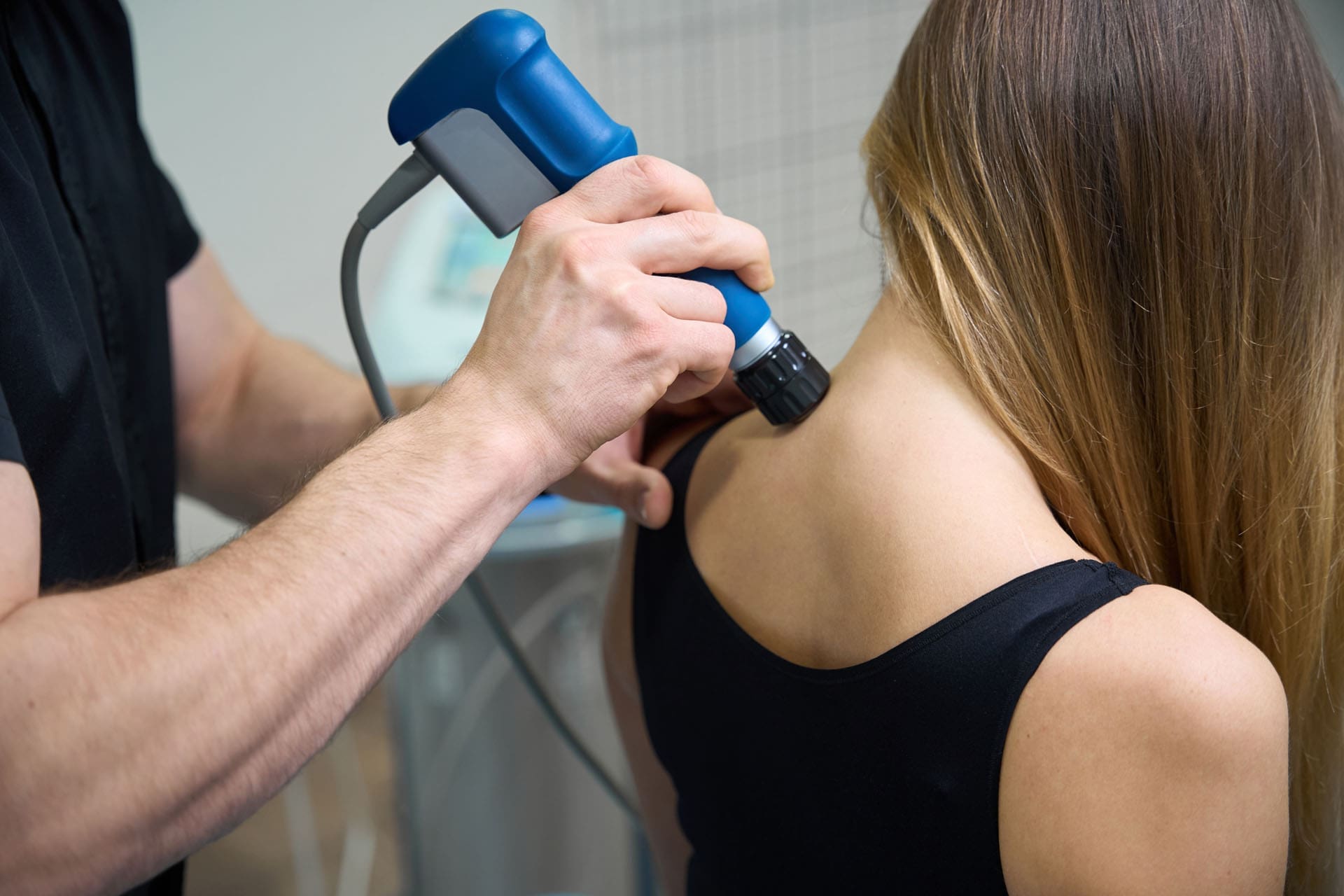
Most sessions are brief. Patients often experience rapid pulses and warmth, with discomfort usually kept at a tolerable level. UCHealth advises patients to stay within a moderate discomfort range and notes that mild swelling or redness may occur.
A typical visit may include:
-
A focused exam and plan update
-
Gel on the skin to help transmit the waves
-
A handheld device delivering pulses to the target region
-
Re-checking movement and symptoms after treatment
Many clinics emphasize minimal downtime and a quick return to normal activity, depending on the condition and your provider’s guidance.
Why combining ESWT with chiropractic and nurse practitioner care can be a game-changer
Post-accident recovery usually fails when care is too narrow. MVAs often involve:
-
Soft tissue injury (tendons, ligaments, fascia)
-
Joint irritation or restriction (neck, thoracic spine, lumbar spine, ribs, SI joints)
-
Nervous system sensitization (headaches, sleep disruption, persistent tightness)
-
Functional problems (posture, gait, lifting tolerance, desk work tolerance)
That is why a combined model can work well:
ESWT: deep tissue regeneration support
ESWT targets slow-healing tissue and can help reduce adhesions, improve circulation, and support collagen remodeling.
Chiropractic care: structural alignment and motion restoration
Chiropractic care focuses on restoring joint movement and alignment patterns that can keep tissues from becoming irritated. In integrative models, adjustments are used to reduce mechanical stress and improve function while soft tissue heals.
Nurse practitioner (NP) oversight: broader medical decision-making and documentation
An NP role can add value to injury care by supporting differential diagnosis, coordinating imaging or referrals when needed, monitoring red flags, and helping manage recovery barriers such as sleep issues, inflammation load, and functional limitations. (In post-accident cases, medical documentation and careful tracking of progress can also matter.) This “big picture” approach matches how multidisciplinary injury models describe comprehensive post-accident recovery planning.
A real-world clinical pattern (Dr. Alexander Jimenez’s observations)
Dr. Jimenez describes using shockwave clinically to address more than one “spot” of pain. Instead, it can be applied across surrounding tight tissues to treat trigger points, fascial restrictions, and movement compensations, helping the body shift out of the pain cycle and restore more normal function.
Safety, side effects, and realistic expectations
ESWT is widely described as noninvasive and drug-free. Still, it is not “nothing.” It is energy delivered into tissue, and it must be used properly.
Mayo Clinic notes documented side effects such as:
-
skin redness (erythema)
-
mild bruising
-
pain at the application site
Mayo Clinic also mentions less consensus on complications, with examples including hematoma formation, nerve irritation, edema, and a theoretical risk of tendon rupture, emphasizing the importance of proper administration and patient counseling.
A focused shockwave FAQ also notes that mild swelling, redness, or soreness can occur and is usually temporary.
Important note: Your provider should screen you for contraindications and red flags before treatment. If you have worsening neurological symptoms (like progressive weakness), severe unrelenting pain, signs of fracture, infection concerns, or other serious findings, you need a full medical evaluation first.
How to get the best results after an accident (simple, practical steps)
ESWT works best when your daily habits support healing. After MVAs, the basics matter:
-
Protect sleep: tissue repair depends on sleep quality
-
Hydrate and eat enough protein: collagen remodeling needs nutrients
-
Do your rehab drills: gentle range-of-motion and strengthening keep gains from “fading”
-
Avoid re-injury: do not jump back into heavy lifting or aggressive stretching too fast
-
Track progress: pain scores are helpful, but function matters more (driving, turning your head, walking tolerance, sitting tolerance)
Many clinics emphasize that early, targeted care can help reduce the risk of chronic symptoms after auto injuries.
The bottom line
Genuine ESWT can be a high-value tool for MVA recovery because it delivers a strong mechanical signal into injured tissue, supporting healing through mechanotransduction, improved circulation, pain modulation, and tissue remodeling.
Most people feel meaningful improvement within a few sessions, but full recovery plans often require multiple visits based on severity, the number of injured regions, and how long symptoms have been present.
When ESWT is combined with chiropractic care (to restore motion and reduce mechanical stress) and NP-guided oversight (to broaden clinical decision-making, coordinate care, and track whole-body recovery), the result can be faster healing, better function, and a lower risk of chronic pain.

References
-
Advanced Back and Neck Care. (2025). Shockwave therapy for motor vehicle accidents in Lumberton, NJ.
-
Dunn Physical Therapy Partners. (n.d.). How shockwave therapy can help injuries.
-
Jimenez, A. (2026). Shockwave therapy for healing: Understanding ESWT.
-
Jimenez, A. (2026). A deep dive into regenerative medicine: Unlocking the synergistic power of shockwave therapy and platelet-rich plasma (PRP).
-
Mayo Clinic. (2025). Shockwave treatment: A new wave for musculoskeletal care.
-
Preferred Family Chiropractic. (2025). Recover from auto accident injuries with shockwave therapy.
-
Simplicio, C. L., Purita, J., Murrell, W., Santos, G. S., Dos Santos, R. G., Lana, J. F. S. D., & … (2020). Extracorporeal shock wave therapy mechanisms in musculoskeletal regenerative medicine. International Journal of Surgery, 82, 11–18.
-
UCHealth Today. (n.d.). Shockwave therapy can help those who have chronic injuries.
-
Trinity Advanced Health. (2024). Enhancing recovery: How chiropractic care, shockwave therapy, and laser therapy work together for soft tissue injuries.
-
Martínez-Silván, D., et al. (2023). The role of extracorporeal shock wave therapy in the treatment of muscle injuries: A systematic review. Cureus, 15(8).
-
Hope Health & Wellness. (n.d.). Non-invasive shockwave therapy for pain relief.
-
El Paso Back Clinic. (2026). El Paso back clinic ESWT for chronic pain relief.
-
Chiropractic Clinics of South Florida. (n.d.). What is shock wave therapy (ESWT)?.
-
Health Coach Clinic. (2026). Combining ESWT with chiropractic for effective healing.
Professional Scope of Practice *
The information herein on "ESWT for Motor Vehicle Accident Injuries Recovery" is not intended to replace a one-on-one relationship with a qualified health care professional or licensed physician and is not medical advice. We encourage you to make healthcare decisions based on your research and partnership with a qualified healthcare professional.
Blog Information & Scope Discussions
Welcome to El Paso's Premier Wellness and Injury Care Clinic & Wellness Blog, where Dr. Alex Jimenez, DC, FNP-C, a Multi-State board-certified Family Practice Nurse Practitioner (FNP-BC) and Chiropractor (DC), presents insights on how our multidisciplinary team is dedicated to holistic healing and personalized care. Our practice aligns with evidence-based treatment protocols inspired by integrative medicine principles, similar to those found on this site and our family practice-based chiromed.com site, focusing on restoring health naturally for patients of all ages.
Our areas of multidisciplinary practice include Wellness & Nutrition, Chronic Pain, Personal Injury, Auto Accident Care, Work Injuries, Back Injury, Low Back Pain, Neck Pain, Migraine Headaches, Sports Injuries, Severe Sciatica, Scoliosis, Complex Herniated Discs, Fibromyalgia, Chronic Pain, Complex Injuries, Stress Management, Functional Medicine Treatments, and in-scope care protocols.
Our information scope is multidisciplinary, focusing on musculoskeletal and physical medicine, wellness, contributing etiological viscerosomatic disturbances within clinical presentations, associated somato-visceral reflex clinical dynamics, subluxation complexes, sensitive health issues, and functional medicine articles, topics, and discussions.
We provide and present clinical collaboration with specialists from various disciplines. Each specialist is governed by their professional scope of practice and their jurisdiction of licensure. We use functional health & wellness protocols to treat and support care for musculoskeletal injuries or disorders.
Our videos, posts, topics, and insights address clinical matters and issues that are directly or indirectly related to our clinical scope of practice.
Our office has made a reasonable effort to provide supportive citations and has identified relevant research studies that support our posts. We provide copies of supporting research studies upon request to regulatory boards and the public.
We understand that we cover matters that require an additional explanation of how they may assist in a particular care plan or treatment protocol; therefore, to discuss the subject matter above further, please feel free to ask Dr. Alex Jimenez, DC, APRN, FNP-BC, or contact us at 915-850-0900.
We are here to help you and your family.
Blessings
Dr. Alex Jimenez DC, MSACP, APRN, FNP-BC*, CCST, IFMCP, CFMP, ATN
email: [email protected]
Multidisciplinary Licensing & Board Certifications:
Licensed as a Doctor of Chiropractic (DC) in Texas & New Mexico*
Texas DC License #: TX5807, Verified: TX5807
New Mexico DC License #: NM-DC2182, Verified: NM-DC2182
Multi-State Advanced Practice Registered Nurse (APRN*) in Texas & Multi-States
Multi-state Compact APRN License by Endorsement (42 States)
Texas APRN License #: 1191402, Verified: 1191402 *
Florida APRN License #: 11043890, Verified: APRN11043890 *
Colorado License #: C-APN.0105610-C-NP, Verified: C-APN.0105610-C-NP
New York License #: N25929, Verified N25929
License Verification Link: Nursys License Verifier
* Prescriptive Authority Authorized
ANCC FNP-BC: Board Certified Nurse Practitioner*
Compact Status: Multi-State License: Authorized to Practice in 40 States*
Graduate with Honors: ICHS: MSN-FNP (Family Nurse Practitioner Program)
Degree Granted. Master's in Family Practice MSN Diploma (Cum Laude)
Dr. Alex Jimenez, DC, APRN, FNP-BC*, CFMP, IFMCP, ATN, CCST
My Digital Business Card
Licenses and Board Certifications:
DC: Doctor of Chiropractic
APRNP: Advanced Practice Registered Nurse
FNP-BC: Family Practice Specialization (Multi-State Board Certified)
RN: Registered Nurse (Multi-State Compact License)
CFMP: Certified Functional Medicine Provider
MSN-FNP: Master of Science in Family Practice Medicine
MSACP: Master of Science in Advanced Clinical Practice
IFMCP: Institute of Functional Medicine
CCST: Certified Chiropractic Spinal Trauma
ATN: Advanced Translational Neutrogenomics
Memberships & Associations:
TCA: Texas Chiropractic Association: Member ID: 104311
AANP: American Association of Nurse Practitioners: Member ID: 2198960
ANA: American Nurse Association: Member ID: 06458222 (District TX01)
TNA: Texas Nurse Association: Member ID: 06458222
NPI: 1205907805
| Primary Taxonomy | Selected Taxonomy | State | License Number |
|---|---|---|---|
| No | 111N00000X - Chiropractor | NM | DC2182 |
| Yes | 111N00000X - Chiropractor | TX | DC5807 |
| Yes | 363LF0000X - Nurse Practitioner - Family | TX | 1191402 |
| Yes | 363LF0000X - Nurse Practitioner - Family | FL | 11043890 |
| Yes | 363LF0000X - Nurse Practitioner - Family | CO | C-APN.0105610-C-NP |
| Yes | 363LF0000X - Nurse Practitioner - Family | NY | N25929 |
Dr. Alex Jimenez, DC, APRN, FNP-BC*, CFMP, IFMCP, ATN, CCST
My Digital Business Card