Find out how PRP therapy can be a game changer for plantar fasciitis and Achilles tendon pain management on the feet.
Table of Contents
Abstract
In this educational overview, I, Dr. Alex Jimenez, will guide you through a paradigm shift in understanding and treating chronic heel pain, commonly diagnosed as plantar fasciitis. For years, the standard approach has focused on directly treating the plantar fascia itself—often with painful injections and limited long-term success. However, groundbreaking clinical insights and emerging research now point to a different culprit: the Achilles tendon and the gastrocnemius-soleus complex. We will explore the biomechanical and physiological reasons why dysfunction in the calf and Achilles leads to the painful micro-tears in the plantar fascia. This post details an innovative, evidence-based injection protocol targeting the Achilles tendon, developed through clinical collaboration and supported by research. We will discuss the specific techniques, the rationale behind them, and how this approach integrates seamlessly into a comprehensive, multidisciplinary care model. This model, which we practice at our clinic, combines advanced regenerative medicine with the foundational principles of chiropractic care, medical oversight, functional medicine, and rehabilitation to achieve lasting relief and restore function. We will also introduce the vital collaborative role of Dr. Maria Guadalupe Cardenas, MD, our distinguished Medical Director, whose expertise in internal medicine provides essential medical oversight for our integrative patient care protocols.
A Message from Dr. Alex Jimenez, DC, APRN, FNP-BC, CFMP, IFMCP, ATN, CCST
Hello, and welcome. I am Dr. Alex Jimenez, and I am honored to share with you some of the latest, most effective strategies for managing chronic heel pain. With a deep background in chiropractic, functional medicine, and as a board-certified Family Nurse Practitioner, my mission has always been to find the root cause of my patients’ suffering and provide solutions that are not just palliative but truly corrective.

Here at Injury Medical Clinic PA in El Paso, Texas, we have cultivated a unique, multidisciplinary environment. Our strength lies in our collaborative team approach. I work hand-in-hand with Dr. Maria Guadalupe Cardenas, MD, our esteemed Medical Director and Collaborative Physician. Dr. Cardenas is Board Certified in Internal Medicine and brings over four decades of invaluable experience to our practice. Her role is crucial; she provides the essential medical direction and oversight that allows us to safely and effectively integrate advanced procedures, like the ones we’ll discuss today, with our core services of chiropractic care, rehabilitation, and functional medicine. This synergy ensures that our patients receive a comprehensive, safe, and holistic treatment plan tailored to their specific needs, whether they are recovering from a personal injury or dealing with a chronic condition.
What you are about to read is the culmination of years of clinical practice, collaboration with leading orthopedic surgeons, and a relentless pursuit of better outcomes for patients told their heel pain is something they have to “live with.” Let’s embark on this journey together and redefine how we approach plantar fasciitis.
Rethinking Plantar Fasciitis: The True Origin of Heel Pain
For decades, the medical community has approached plantar fasciitis with the assumption that the problem lies solely within the plantar fascia itself—the thick band of tissue that runs across the bottom of the foot, connecting the heel bone to the toes. This has led to treatments aimed directly at this structure: steroid injections, aggressive stretching, and even surgery. While these methods can provide temporary relief, they often fail to address the underlying cause, leading to high rates of recurrence and, in some cases, further damage, such as fat pad atrophy.
My clinical observations, supported by the work of innovative researchers, have led me to a different conclusion: in most cases of chronic, non-traumatic heel pain, the plantar fascia is the victim, not the culprit. The true problem originates higher up the kinetic chain, specifically within the gastrocnemius-soleus complex (your calf muscles) and its connection to the heel via the Achilles tendon.
The Biomechanical Connection: How Calf Tightness Damages the Foot
To understand this concept, we need to think of the lower leg and foot as an interconnected system.
- The Windlass Mechanism: The plantar fascia plays a crucial role in the normal biomechanics of walking through what is known as the windlass mechanism. As you push off your toes, the fascia tightens, elevating the arch, stiffening the foot, and creating a rigid lever for efficient propulsion.
- The Role of the Achilles: The Achilles tendon, the strongest and thickest tendon in the body, connects the powerful calf muscles to the heel bone (calcaneus). It is responsible for plantarflexion (pointing your foot down).
- The Tug-of-War: An imbalance in this system creates a pathological “tug-of-war” on the calcaneus. When the gastrocnemius and soleus muscles are chronically tight, a condition often stemming from tendinosis (a degenerative state of the tendon), they exert a constant, excessive pulling force on the back of the heel through the Achilles tendon.
Think about what happens overnight. As you sleep, your calf muscles are in a relaxed, shortened state, and your foot naturally falls into a position of plantarflexion. This allows the tight Achilles tendon to pull on the heel, which in turn keeps the plantar fascia in a shortened, slackened state for hours.
Then, your alarm goes off. You stand up, and your entire body weight is suddenly forced onto your foot. This action violently stretches the plantar fascia, which has been in a contracted state all night. This abrupt, forceful stretch is what causes the characteristic stabbing pain of the first few steps in the morning. These are not just feelings of stiffness; they are the result of micro-tears occurring in the fascia at its insertion point on the heel. Day after day, this cycle of nocturnal shortening followed by abrupt morning stretching perpetuates a state of chronic injury, inflammation, and degeneration in the plantar fascia. The body tries to heal, but it is re-injured every single morning.
This is why treatments focused only on the plantar fascia fail. An injection into the fascia might calm the inflammation, but it does nothing to release the relentless tension from the Achilles tendon. We are simply treating the symptom while ignoring the disease. The real solution lies in addressing the Achilles tendinosis and the associated tightness in the gastrocnemius-soleus complex. By releasing this tension, we allow the plantar fascia the biomechanical freedom it needs to heal naturally.
A Revolutionary Treatment Protocol: Targeting the Achilles Tendon
Based on this understanding, a new treatment protocol has been developed—one that I, along with my orthopedic colleagues, have refined over the past decade with remarkable success. This technique was born from a collaborative discussion with an orthopedic surgeon, Dr. Roman, who was frustrated with the poor outcomes of traditional plantar fascia treatments, including fat pad replacement surgeries. Over a series of conversations (and a few Moscow Mules on bar napkins, as the story goes), we mapped out a logical, anatomy-based approach. We hypothesized that if we could treat the tendinosis in the Achilles, we could resolve the downstream problem in the plantar fascia. The clinical results that followed have been nothing short of transformative.
The protocol involves a series of targeted injections into the Achilles tendon itself, rather than the exquisitely sensitive bottom of the foot. The goal is to stimulate a healing response within the degenerated tendon tissue, improve its flexibility, and reduce the chronic tension on the calcaneus.
Identifying the Injection Sites: A Precise, Palpation-Based Approach
Precision is key to this procedure. We don’t just inject randomly; we use careful anatomical landmarks and palpation to identify the exact points of dysfunction.
1. The Mid-Substance Achilles Tendon Injection
The primary target is the “watershed” area of the Achilles tendon, a region approximately 2-6 cm above its insertion on the heel. This area has a relatively poor blood supply, making it susceptible to degeneration (tendinosis) and slow to heal.
- Patient Positioning: The patient lies face down (prone) on the treatment table with their feet hanging off the edge. This position allows the calf muscles to relax and provides clear access to the Achilles tendon.
- Locating the Bifurcation: To find the precise entry point, I have the patient gently push their foot against my leg to engage the calf muscles. I then run my thumb superiorly (upward) along the Achilles tendon. I am feeling for a specific landmark: the musculotendinous junction, where the fibers of the gastrocnemius muscle begin to merge into the tendon. This junction often feels like a subtle “bifurcation” or split. This is a critical area of tension and is often tender to the touch. Once I identify this spot, the patient can relax their leg.
- The Entry Point: This palpable bifurcation becomes our entry point. It represents the upper boundary of the tendinopathic zone we intend to treat.
2. The Achilles Tendon Insertion Injections
The second area of focus is the enthesis—the point where the Achilles tendon inserts directly onto the calcaneus (heel bone). This area is also subject to immense stress and is a common site of degenerative change and pain.
- Palpation is Key: With the patient’s foot relaxed, I palpate the very bottom of the Achilles tendon where it fans out and attaches to the bone. This area often feeBoneropey” or fibrotic.
- Identifying Maximum Tenderness: I apply gentle pressure to both the medial (inner) and lateral (outer) sides of the insertion. I ask the patient, “Is it more tender on the inside or the outside?” Most patients report significantly more tenderness on the medial side, which corresponds to the area of greatest mechanical strain.
- Marking the Sites: The points of maximum tenderness on the medial and lateral aspects of the insertion become our secondary injection targets.
The Injection Technique: A Step-by-Step Guide
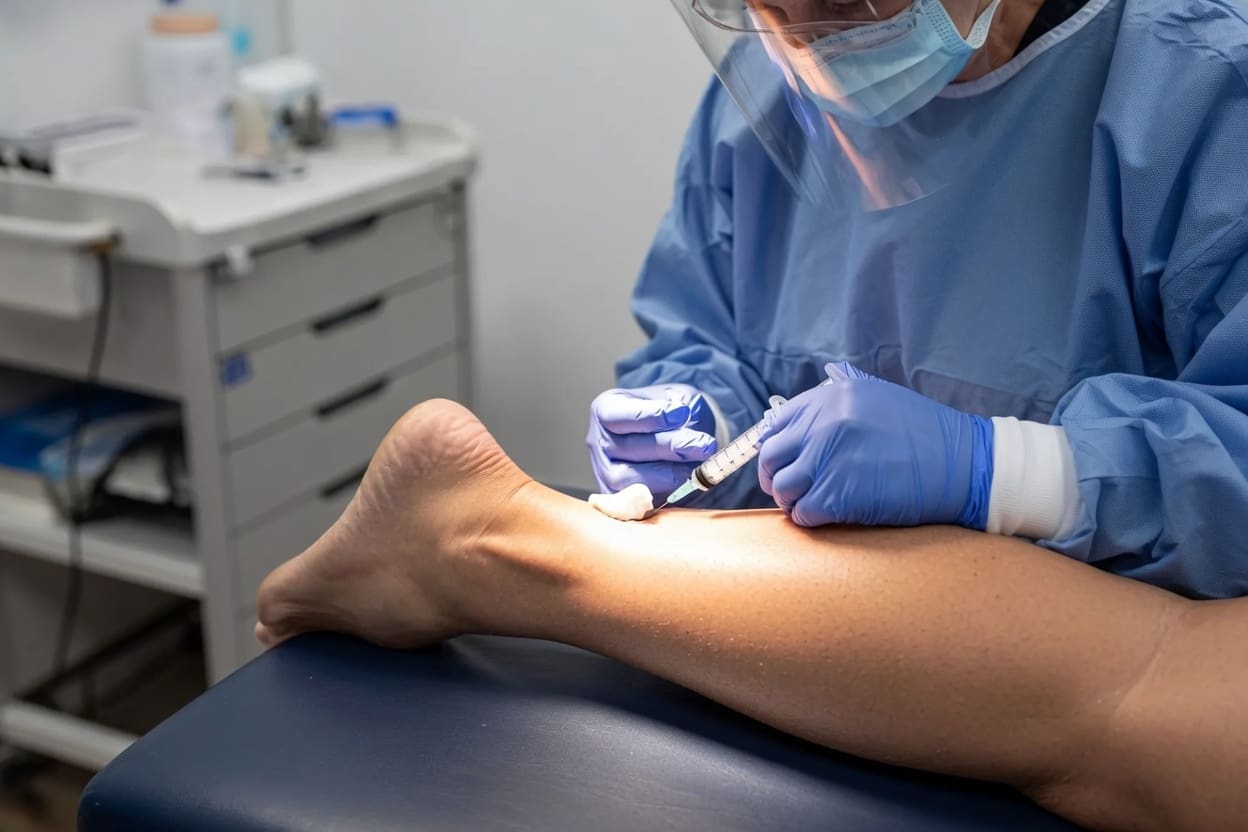
With our landmarks identified, we can proceed with the injections. This demonstration uses a biologic allograft solution, but the technique is similar for Platelet-Rich Plasma (PRP) or prolotherapy. The key is to deliver the healing substance accurately into the degenerated tendon tissue.
Procedure for the Mid-Substance Injection
- Preparation: The area is thoroughly cleaned with an antiseptic solution. We use a 5 cc syringe, which, for this protocol, is split between the primary site and the insertion sites.
- Needle Entry: Using a 1.5-inch needle, I enter the skin at the pre-identified bifurcation point. The bevel of the needle should be pointed up. I advance the needle perpendicularly through the skin and subcutaneous tissue, about halfway in.
- Angling Down into the Tendon: This is the most crucial step. Once the needle is about halfway in, I change the angle, dropping it down so it runs parallel to the tendon fibers. I then advance the needle deeper into the core of the tendon.
- Feeling the Tissue Change: As the needle enters the tendon, there is a distinct change in tactile sensation. It goes from the soft, yielding feel of subcutaneous fat to a much firmer, denser, almost “gritty” feel. This confirms that we are inside the tendon sheath and within the substance of the tendon itself. This proprioceptive feedback is essential for accurate placement.
- Injection: Once I’m confident in the placement, I slowly and gently inject the solution (in this case, 1- 2.5 cc, depending on the total volume available). The goal is to bathe the degenerated fibers in the regenerative substance.
Procedure for the Insertion Site Injections
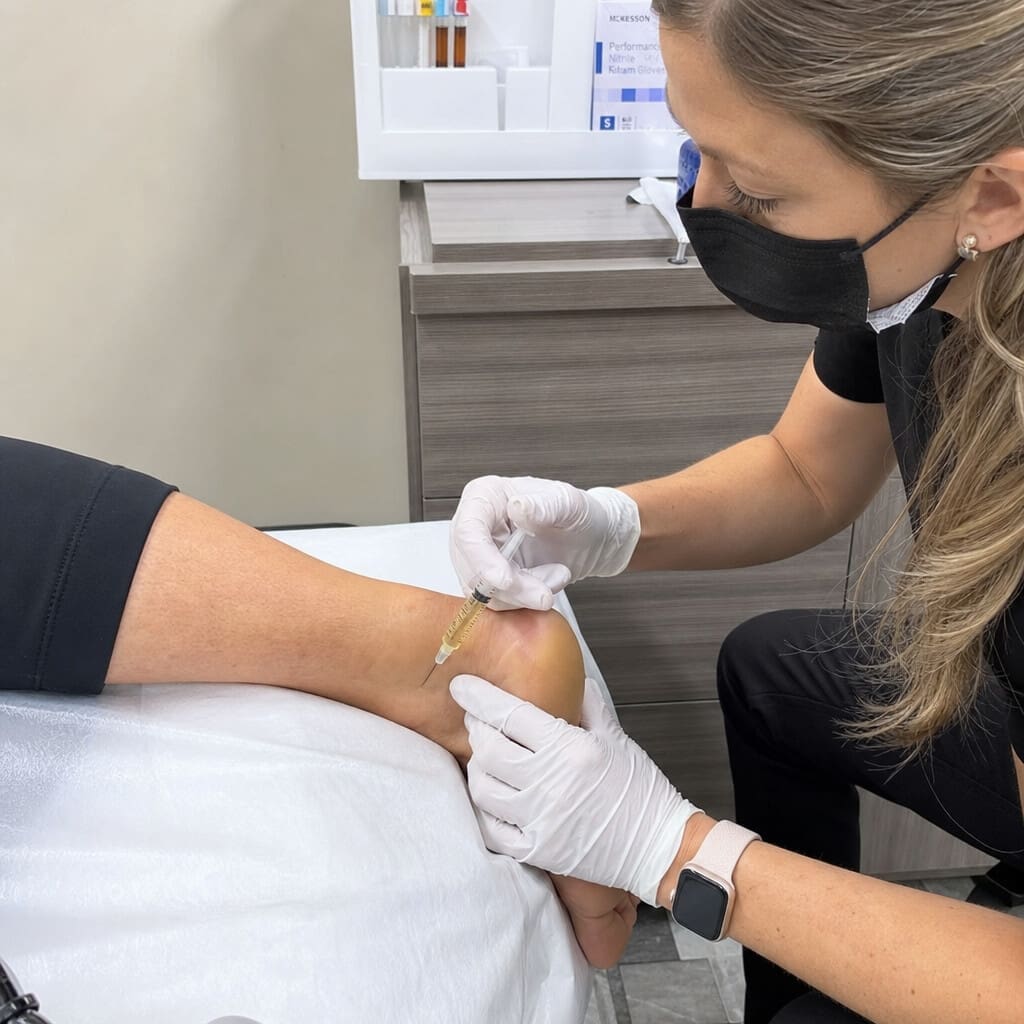
- Angled Approach: For the insertion points on the heel, the approach is different. I come in at an angle, directing the needle toward the point of maximum tenderness on the bone where the tendon attaches.
- Contacting the Bone: I advance the needle until I gently make contact with the periosteum (the outer surface of the bone).
- Aspiration (A CritBone Safety Step): Before injecting, I aspirate by pulling back on the plunger. This is a non-negotiable safety check. If blood flashes into the hub of the syringe, it means the needle tip is inside a blood vessel. Injecting into a vessel, especially if the solution contains an anesthetic like lidocaine, can cause serious systemic complications. If a flash occurs, I withdraw the needle, clear it, and find a new trajectory.
- Injection: If the aspiration is clear (no blood return), I proceed to inject a small amount (e.g., 0.5 cc) of the solution directly onto the enthesis. This is repeated for both the medial and lateral insertion points.
Why This Technique Works: The Physiology of Healing
Whether using PRP, prolotherapy, or other biologic allografts, the underlying principle is the same: we are kick-starting the body’s own healing cascade in a tissue that has become stuck in a degenerative, non-healing state.
- PRP (Platelet-Rich Plasma): PRP is a concentration of platelets from the patient’s own blood. Platelets are the first responders to injury. When injected into the degenerated tendon, they release a host of powerful growth factors (e.g., PDGF, TGF-β, VEGF). These signaling molecules orchestrate the healing process by:
-
- Attracting stem cells to the site of injury.
- Stimulating the formation of new blood vessels (angiogenesis), which improves nutrient delivery and waste removal.
- Promoting the synthesis of new, healthy collagen fibers, which are the building blocks of the tendon.
- Prolotherapy: Prolotherapy solutions, typically containing dextrose (a sugar), work by creating a controlled, localized inflammatory response. This “therapeutic inflammation” essentially tricks the body into recognizing the old, chronic injury as a new, acute one. This re-ignites the healing cascade (inflammation -> proliferation -> remodeling) that had previously stalled. While effective, prolotherapy is generally less potent than PRP and may require more treatment sessions (e.g., 6-8 weekly or bi-weekly treatments) to achieve comparable results.
By targeting the Achilles tendon with these regenerative techniques, we are not just masking pain; we are fundamentally changing the tissue at a cellular level. We are transforming a weak, degenerated, and tight tendon into a stronger, more flexible, and healthier one. This, in turn, eliminates abnormal tensile forces on the plantar fascia, allowing it to heal.
Integrating Chiropractic Care for Comprehensive Recovery
While this injection protocol is a powerful tool, it is most effective when integrated into a comprehensive rehabilitation program. This is where the principles of chiropractic and functional medicine become indispensable. As a chiropractor, my focus extends beyond the injection site to the entire musculoskeletal system.
Chiropractic care plays a pivotal role in post-procedure recovery and long-term prevention. The goal is to correct the underlying biomechanical faults that may have contributed to the development of Achilles tendinosis in the first place.
Restoring Proper Joint Mechanics
- Foot and Ankle Adjustments: After an injury and a period of altered gait (limping), the 26 bones of the foot and ankle can become misaligned and restricted. I perform specific chiropractic adjustments to the subtalar joint, talonavicular joint, and other intertarsal joints. Restoring proper mobility in these joints is critical for re-establishing the foot’s natural shock-absorbing capabilities and ensuring the windlass mechanism functions correctly.
- Knee, Hip, and Sacroiliac Adjustments: The kinetic chain is a two-way street. A problem in the foot can cause compensations that lead to dysfunction in the knee, hip, and pelvis. Conversely, a primary misalignment in the sacroiliac joint or lumbar spine can alter a person’s gait, placing abnormal stress on the foot and ankle. A full-spine and extremity assessment is crucial. By ensuring the entire kinetic chain is moving freely and in alignment, we reduce compensatory stress on the healing Achilles tendon and plantar fascia.
Rehabilitation and Patient Education
The recovery process doesn’t end in the clinic. Active patient participation is essential.
- The Post-Injection Boot: Immediately following the procedure, patients are typically placed in a walking boot for a few days. The purpose of the boot is to immobilize the ankle and offload the newly treated tendon, protecting it from excessive strain during the initial, critical phase of inflammation and healing.
- Controlled Stretching: After about three days, the patient can begin a gentle and controlled calf stretching program. This must be done correctly. The goal is not to aggressively stretch the foot but to apply a long-duration, low-load stretch to the gastrocnemius and soleus muscles. This helps to remodel the new collagen fibers in the tendon in a lengthened, more functional alignment.
- Strengthening Exercises: As healing progresses, we introduce eccentric strengthening exercises for the calf muscles. Eccentric contractions (where the muscle lengthens under load, such as slowly lowering your heels off a step) are particularly effective for treating tendinopathies. These exercises stimulate collagen production and improve the tensile strength of the tendon.
- Gait Analysis and Orthotics: We assess the patient’s walking and running patterns to identify any persistent biomechanical flaws, such as overpronation. In some cases, custom-molded orthotics may be recommended to provide appropriate arch support and correct foot posture, preventing future recurrence.
This integrative approach is the hallmark of our practice. The targeted regenerative injection, performed under the medical direction of Dr. Cardenas, addresses the pathology at the cellular level. The chiropractic adjustments restore the foundational biomechanical framework. And the guided rehabilitation program rebuilds strength and function. It’s this synergy that leads to lasting results.
Conclusion: A New Hope for Heel Pain Sufferers
The traditional approach to plantar fasciitis has left countless individuals in a cycle of pain, frustration, and disability. The paradigm shift toward treating the Achilles tendon as the primary driver of the condition offers a new, more effective path forward. This anatomy-driven, evidence-based protocol, which I have seen succeed time and time again in my clinical practice over the last decade, represents a significant advancement in the management of chronic heel pain.
By understanding that the plantar fascia is often the “victim” of dysfunction higher up the kinetic chain, we can redirect our therapeutic efforts to the root cause: Achilles tendinosis. Through precise, regenerative injections aimed at healing the tendon, we can release the chronic tension that damages the foot.
When this powerful intervention is combined with holistic chiropractic care to restore biomechanical integrity and a structured rehabilitation program to rebuild strength, we create an environment where the body can truly heal itself. This integrative model, championed by our collaborative team at Injury Medical Clinic PA, provides a comprehensive solution that not only alleviates pain but restores function and offers a genuine opportunity for a pain-free life. If you have been struggling with chronic heel pain, know that there is hope and there are better options available.
References and Further Reading
- Ahmad, J., & Jones, K. J. (2014). Insertional Achilles Tendinopathy. JBJS Reviews, 2(12), e3. https://doi.org/10.2106/JBJS.RVW.N.00032
- Carcia, C. R., Martin, R. L., Houck, J., & Wukich, D. K. (2010). Achilles Pain, Plantar Fasciitis, and Related Pathology. Journal of Orthopaedic & Sports Physical Therapy, 40(9), A1-A26. https://doi.org/10.2519/jospt.2010.0305
- Cheung, J. T., An, K. N., & Zhang, M. (2006). Consequences of partial and total plantar fascia release: a finite element study. Foot & Ankle International, 27(2), 125-132. https://doi.org/10.1177/107110070602700208
- de Vos, R. J., Weir, A., van Schie, H. T., Bierma-Zeinstra, S. M., Verhaar, J. A., Weinans, H., & Tol, J. L. (2010). Platelet-rich plasma injection for chronic Achilles tendinopathy: a randomized controlled trial. JAMA, 303(2), 144-149. https://doi.org/10.1001/jama.2009.1986
- Martin, R. L., Davenport, T. E., Reischl, S. F., McPoil, T. G., Matheson, J. W., Wukich, D. K., … & Godges, J. J. (2014). Heel pain—plantar fasciitis: revisión 2014. Journal of Orthopaedic & Sports Physical Therapy, 44(11), A1-A33. https://doi.org/10.2519/jospt.2014.0303
- Rabago, D., & Nourani, B. (2017). Prolotherapy for Musculoskeletal Pain. PM&R: The Journal of Injury, Function, and Rehabilitation, 9(9S), S230-S238. https://doi.org/10.1016/j.pmrj.2017.06.012
- Sampson, S., Gerhardt, M., & Mandelbaum, B. (2008). Platelet-rich plasma injection grafts for musculoskeletal injuries: a review. Current Reviews in Musculoskeletal Medicine, 1(3-4), 165–174. https://doi.org/10.1007/s12178-008-9032-5
- Young, C. C., Rutherford, D. S., & Niedfeldt, M. W. (2001). Treatment of plantar fasciitis. American Family Physician, 63(3), 467-474. https://www.aafp.org/pubs/afp/issues/2001/0201/p467.html
SEO Tags: Plantar Fasciitis Treatment, Heel Pain Relief, Achilles Tendinosis, Dr. Alex Jimenez, Dr. Maria Cardenas, Integrative Chiropractic Care El Paso, PRP for Achilles, Prolotherapy for Heel Pain, Regenerative Medicine, Functional Medicine, Chronic Heel Pain, Calf Tightness and Foot Pain, Biomechanics of the Foot, Non-Surgical Heel Pain Solution, Injury Medical Clinic, El Paso Chiropractor, Musculoskeletal Health, Windlass Mechanism, Tendinopathy Treatment, Personal Injury Care
Professional Scope of Practice *
The information herein on "PRP Therapy Results on Plantar Fasciitis on the Achilles Tendon" is not intended to replace a one-on-one relationship with a qualified health care professional or licensed physician and is not medical advice. We encourage you to make healthcare decisions based on your research and partnership with a qualified healthcare professional.
Blog Information & Scope Discussions
Welcome to El Paso's Premier Wellness and Injury Care Clinic & Wellness Blog, where Dr. Alex Jimenez, DC, FNP-C, a Multi-State board-certified Family Practice Nurse Practitioner (FNP-BC) and Chiropractor (DC), presents insights on how our multidisciplinary team is dedicated to holistic healing and personalized care. Our practice aligns with evidence-based treatment protocols inspired by integrative medicine principles, similar to those found on this site and our family practice-based chiromed.com site, focusing on restoring health naturally for patients of all ages.
Our areas of multidisciplinary practice include Wellness & Nutrition, Chronic Pain, Personal Injury, Auto Accident Care, Work Injuries, Back Injury, Low Back Pain, Neck Pain, Migraine Headaches, Sports Injuries, Severe Sciatica, Scoliosis, Complex Herniated Discs, Fibromyalgia, Chronic Pain, Complex Injuries, Stress Management, Functional Medicine Treatments, and in-scope care protocols.
Our information scope is multidisciplinary, focusing on musculoskeletal and physical medicine, wellness, contributing etiological viscerosomatic disturbances within clinical presentations, associated somato-visceral reflex clinical dynamics, subluxation complexes, sensitive health issues, and functional medicine articles, topics, and discussions.
We provide and present clinical collaboration with specialists from various disciplines. Each specialist is governed by their professional scope of practice and their jurisdiction of licensure. We use functional health & wellness protocols to treat and support care for musculoskeletal injuries or disorders.
Our videos, posts, topics, and insights address clinical matters and issues that are directly or indirectly related to our clinical scope of practice.
Our office has made a reasonable effort to provide supportive citations and has identified relevant research studies that support our posts. We provide copies of supporting research studies upon request to regulatory boards and the public.
We understand that we cover matters that require an additional explanation of how they may assist in a particular care plan or treatment protocol; therefore, to discuss the subject matter above further, please feel free to ask Dr. Alex Jimenez, DC, APRN, FNP-BC, or contact us at 915-850-0900.
We are here to help you and your family.
Blessings
Dr. Alex Jimenez DC, MSACP, APRN, FNP-BC*, CCST, IFMCP, CFMP, ATN
Email: [email protected]
Multidisciplinary Licensing & Board Certifications:
Licensed as a Doctor of Chiropractic (DC) in Texas & New Mexico*
Chiropractic Licenses:
Texas DC License #: TX5807, Verified: TX5807
New Mexico DC License #: NM-DC2182, Verified: NM-DC2182
Nurse Practitioner Licenses:
Texas APRN License #: 1191402, Verified: 1191402 *
New Mexico CNP License #: 90560, Verified 90560
Florida APRN License #: 11043890, Verified: APRN11043890 *
Colorado License #: C-APN.0105610-C-NP, Verified: C-APN.0105610-C-NP
New York License #: N25929, Verified N25929
Georgia APRN License #: GAA-NP005701
Multi-State Advanced Practice Registered Nurse (APRN*) Texas & Multi-States
Multi-state Compact APRN License by Endorsement (43 States)
Compact Status: Multi-State License: Authorized to Practice in 43 States*
Nursing Licensure Compact: Updated Here
DEA Registration: (Drug Enforcement Agency Registered)
All medical (MDs) and family practice providers (FNP-APRN) are registered and licensed to offer various levels of medication.
Verify Providers Here
License Verification Link: Nursys License Verifier
* Prescriptive Authority Authorized (DEA Registered Providers). Call if Required
Board Certification:
ANCC FNP-BC: Board Certified Nurse Practitioner*
Education:
Graduate with Honors: ICHS: MSN-FNP (Family Nurse Practitioner Program)
Degree Granted. Master's in Family Practice, MSN Diploma (Cum Laude)
Dr. Alex Jimenez, DC, APRN, FNP-BC*, CFMP, IFMCP, ATN, CCST
(Board Certified: Family Practice Nurse Practitioner—Multistate)*
(Licensed Nurse Practitioner & Chiropractor - Multistate)*
Clinical Director
DC & FNP License (Review Above)
Digital Business Card
NPI: 1205907805
Dr. Maria Cardenas, MD
(Board Certified: Internal Medicine)
(Licensed Medical Doctor)
Medical Director, Clinical Director & Collaborative Physician
NPI # 1164426748
MD License #: J2933
Licenses and Board Certifications:
MD: Medical Doctor
DC: Doctor of Chiropractic
APRNP: Advanced Practice Registered Nurse
FNP-BC: Family Practice Specialization (Multi-State Board Certified)
FNP-BC: Family Practice Across Life Span (Neonatal to Geriatrics)
RN: Registered Nurse (Multi-State Compact License)
CFMP: Certified Functional Medicine Provider
MSN-FNP: Master of Science in Family Practice Medicine
MSACP: Master of Science in Advanced Clinical Practice
IFMCP: Institute of Functional Medicine
CCST: Certified Chiropractic Spinal Trauma
ATN: Advanced Translational Neutrogenomics
Family with Primary Care Focus (Family Nurse Practitioner or FNP)
- The Family Nurse Practitioner (FNP) promotes, maintains, and restores health for individuals and families across the lifespan. FNPs also identify health risks, promote wellness, and diagnose and manage acute and chronic illness.
- The FNP focuses on comprehensive primary care, promoting healthy lifestyles for patients across the lifespan in settings such as private practice, physician offices, and community health centers.
Memberships & Associations:
TCA: Texas Chiropractic Association: Member ID: 104311
TNA: Texas Nurse Association: Member ID: 06458222
TNP: Texas Nurse Practitioner Association ID: 2025091511
AANP: American Association of Nurse Practitioners: Member ID: 2198960
ANA: American Nurses Association: Member ID: 06458222 (District TX01)
| Primary Taxonomy | Selected Taxonomy | State | License Number |
|---|---|---|---|
| No | 111N00000X - Chiropractor | NM | DC2182 |
| Yes | 111N00000X - Chiropractor | TX | DC5807 |
| Yes | 363LF0000X - Nurse Practitioner - Family | TX | 1191402 |
| Yes | 363LF0000X - Nurse Practitioner - Family | FL | 11043890 |
| Yes | 363LF0000X - Nurse Practitioner - Family | CO | C-APN.0105610-C-NP |
| Yes | 363LF0000X - Nurse Practitioner - Family | NY | N25929 |
| Yes | 363LF0000X - Nurse Practitioner - Family | NM |
90560 |
| Yes | 363LF0000X - Nurse Practitioner - Family | GA | GAA-NP005701 |
Dr. Alex Jimenez, DC, APRN, FNP-BC*, CFMP, IFMCP, ATN, CCST
(Board Certified: Family Practice Nurse Practitioner—Multistate)*
(Primary Care Across Lifespan—Neonatal / Pediatric / Adult / Geriatrics)
(Licensed Nurse Practitioner & Chiropractor - Multistate)*
Clinical Director
Digital Business Card
NPI: 1205907805
Dr. Maria Cardenas, MD
(Board Certified: Internal Medicine)*
(Licensed Medical Doctor)*
Medical Director, Clinical Director & Collaborative Physician
NPI # 1164426748
MD License #: J2933
📆 Schedule Appointment: Schedule 24/7 (Click Here)